
A colleague told me her team cut weekly status report time from half a day to 45 minutes. AI drafts it; she reviews and sends. Faster, cleaner, less painful.
She also mentioned the reports now sound exactly like everyone else’s.
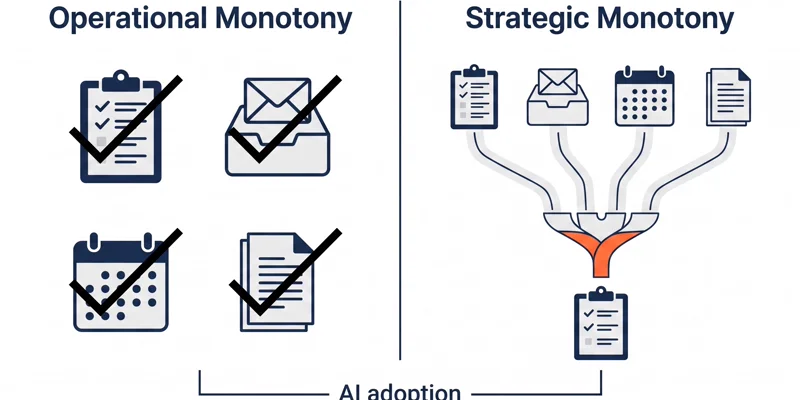
That’s not a small observation. That’s the central tension of AI adoption in business today — what’s quietly being called AI homogenization: the more we automate, the more we start sounding alike.
Operational Monotony: What AI Actually Fixes
For decades, a large chunk of corporate work has been mechanical:
- Building status reports from spreadsheets
- Responding to routine emails
- Generating meeting notes
- Updating documentation
- Assembling standard presentations
AI eliminates most of this. What used to take four hours now takes 30 minutes of review. In that narrow sense, AI is the most significant anti-monotony technology since the PC.
The time freed up is real. The relief is real.
Strategic Monotony: What AI Quietly Creates
Here’s where it gets uncomfortable.
As AI tools become widely available, organizations start using the same models, the same prompt libraries, the same frameworks, the same “best practices.” The outputs that result are — predictably — similar.
Marketing copy that sounds like every other company’s marketing copy. Product descriptions that could belong to any product in the category. Business strategies that mirror the competition’s. Customer communications that feel like they came from a template — because they did.
I call this the AI Average Effect: the phenomenon where organizations using the same AI models, the same prompt libraries, and the same “best practices” produce increasingly similar outputs. Your strategy starts looking like your competitor’s — not because you copied them, but because you both trained the same intelligence engine. Competitive differentiation doesn’t erode through laziness. It erodes through efficiency.
Companies that simply consume AI may become operationally excellent but strategically indistinguishable.
What Actually Becomes Scarce
Before AI, two things were scarce: information and execution capacity. Both are now abundant.
I noticed this pattern on teams that had access to the same AI tools as their competitors. The research looked similar. The decks looked similar. What differed — the only thing — was the call made afterward.
What’s scarce now:
- Judgment — knowing which of AI’s 100 ideas is actually worth pursuing
- Context — the specific constraints, history, and relationships no model was trained on
- Original thinking — connecting dots across domains in ways not in anyone’s training data
- Trust — the kind built through genuine human interaction, not automated touchpoints
The competitive question shifts. It’s no longer “Can we do this work?” It’s “What perspective do we bring that no one else can?”
AI can generate the options. Humans still decide which direction is worth taking.
The Risk for Individual Contributors
Many employees worry AI will make their jobs repetitive. That’s the wrong fear.
The real risk is becoming an AI operator rather than a problem solver.
If your day becomes: ask AI → copy output → send result — you haven’t escaped monotony. You’ve moved it one level up the stack.
It’s the same cognitive outsourcing I wrote about in When AI Does the Homework — just without the grade consequences.
The professionals who compound value in an AI-augmented environment are the ones who:
- Challenge AI outputs rather than rubber-stamp them
- Combine insights across domains the model doesn’t connect
- Ask better questions than they were prompted with
- Apply judgment that requires being inside the organization, not outside it
That’s not about using AI less. It’s about using it deliberately.
Co-Pilot, Not Autopilot
The organizations that win over the next five years won’t be the ones that use AI the most.
They’ll be the ones that use it to clear space — and then actually fill that space with original thinking.
The uncomfortable question is whether most teams will. It’s easier to ship AI output than to push back on it. Easier to accept the convergent answer than to fight for the contrarian one.
AI will commoditize routine excellence. The question is what you’ll do with the time that frees up. That question has a practical dimension: how you spend your AI sessions — the context you load, the precision of your prompts — determines whether you’re generating leverage or just more output.
Use AI to kill operational monotony. Don’t let it kill your distinctiveness in the process.