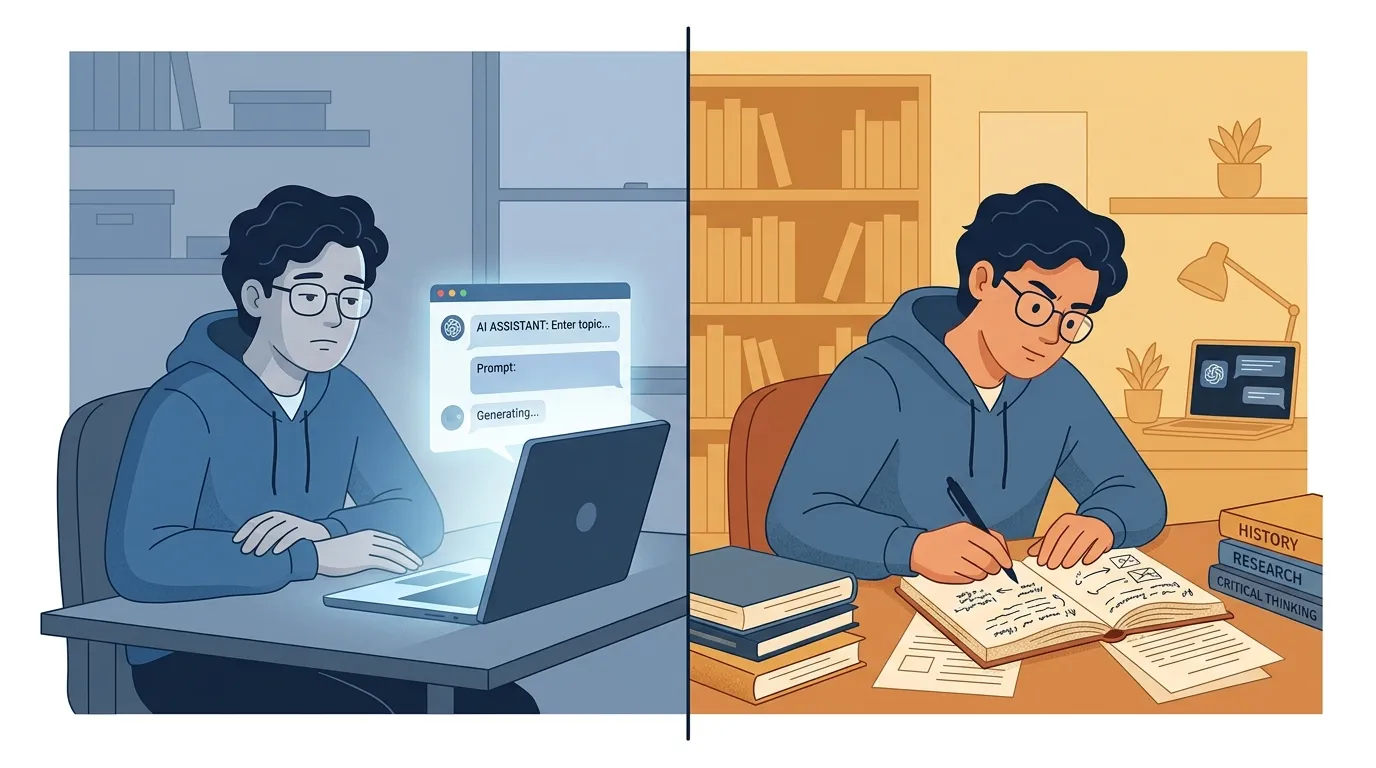
Key Takeaways
- The problem: Students can now outsource entire assignments to AI — not just research, but thinking itself
- Why it matters: Learning happens through struggle; remove the struggle and you remove the learning
- What you’ll learn: Why banning AI is the wrong answer, and how educators can redesign for genuine human development
Calculators didn’t end arithmetic education. The internet didn’t end research skills. Both forced a reckoning — but teachers adapted, eventually.
Generative AI is a different kind of disruption. Educators who treat it as “just another calculator” are going to be blindsided.
A calculator automates computation but still requires the student to understand the problem. A search engine retrieves information but still requires the student to evaluate and synthesize it. Generative AI can handle the full arc — read the prompt, understand the task, produce a complete, coherent response — with the student contributing little more than a copy-paste.
That is not a productivity tool. That is cognitive outsourcing.
The question isn’t whether students will use it. They already are. The question is whether educators will redesign learning around this reality — or keep assigning essays and calling any AI-generated submission cheating while students quietly outpace every detection tool.
The Promise Is Real — Don’t Dismiss It
I want to be honest about something before I get into my concerns.
I use AI every single day. For code, for writing, for thinking through problems I’m stuck on. It has made me faster, sharper, and — I genuinely believe this — more creative in some ways. Not because AI thinks for me. Because it clears the friction between an idea and its first expression, and I can spend my energy on what actually matters.
So when I see it in education, I don’t see a threat by default. I see enormous potential.
Think about what a traditional classroom actually looks like. One teacher, thirty students, one pace. The kid who got it in ten minutes is bored. The kid who needed twenty minutes is already behind. That’s not a teacher failing — it’s a structural impossibility. No human can be thirty tutors at once.
AI can. A student who doesn’t get a concept can ask for five different explanations until one clicks. Another student can be challenged further. No frustration, no waiting, no judgment. That’s genuinely powerful — especially for students who never had access to private tutors or extra support.
And here’s something I didn’t expect when I started thinking about this: AI can actually make some students more creative, not less. The blank page is terrifying. The first draft is always bad. When that starting friction disappears, many students produce more original work because they’re no longer paralyzed by it. The bottleneck was never creativity — it was the courage to start.
Teachers benefit too, though nobody talks about that enough. The hours spent generating practice problems, drafting lesson variations, creating differentiated content — that’s time AI can give back. Time that teachers can spend on what only humans can do: noticing when a student is struggling, pushing them when they’re coasting, being someone worth looking up to.
This is all real. This is all happening. I’ve seen versions of it in how AI changes the work of everyone I work with.
The question is whether it’s happening in addition to learning — or replacing it.
What Generative AI Actually Does to Student Learning
My biggest worry isn’t plagiarism.
Detection tools will get better. Academic integrity policies will get updated. The arms race between AI-generated content and AI detection will eventually stabilize into something workable.
What actually worries me is subtler than cheating. It’s the slow erosion of a student’s willingness — and eventually ability — to think hard things through alone.
Learning lives in the struggle. When you ask a student to write an essay, the goal is not the essay. The goal is the process of constructing an argument: choosing which evidence matters, deciding how to sequence ideas, working through a claim until it’s defensible. That process is where the brain builds something permanent.
When AI produces the essay, the output may be excellent. The brain did almost nothing.
Cognitive outsourcing is a habit, and habits compound. Every time a student encounters a hard problem and reaches for AI before attempting it themselves, they’re training a reflex. Not a skill — a dependency. The question shifts from “How do I solve this?” to “How do I get AI to solve this?” That is not a small shift. It is the difference between an engineer and someone who knows how to prompt an engineer.
Talent is developed, not downloaded. A programmer becomes skilled by debugging a hundred frustrating problems. A writer develops a voice by producing a thousand mediocre pages. An analyst builds intuition by being wrong and figuring out why. Mastery is not the output of a good prompt. It is the residue of sustained effort against resistance.
If students begin their learning journey by offloading that effort, they may produce impressive-looking work while never building the underlying capabilities. They may mistake fluency with AI tools for genuine competence. And so might the people assessing them.
Homogenized thinking. AI responses are generated from patterns in existing information. They tend toward the coherent and the conventional. The breakthroughs in any field — the interesting ideas, the contrarian insights, the things worth publishing or funding or building — rarely come from conventional thinking. If the next generation of writers, researchers, and engineers grows up outsourcing their ideation to systems that average out human thought, we may end up with a generation that is more productive but less original.
Banning AI Is Not the Answer
The future workforce will use AI — not as a novelty, but as a core part of how knowledge work gets done. Educating students in an AI-free bubble and then releasing them into an AI-saturated workplace doesn’t protect them. It disadvantages them.
History also settles this: technological progress cannot be reversed through prohibition. Banning calculators didn’t help students think more deeply. Blocking smartphones didn’t create better researchers. The response to a new tool has to be redesign, not retreat.
The right response is not prohibition. It’s rethinking what we’re actually asking students to do — and why.
What “AI as Coach” Actually Looks Like
The healthiest relationship between a student and AI is the same one I try to have with it professionally: AI handles execution, I supply the judgment.
I don’t ask AI what I think. I don’t ask it to decide what matters. I ask it to help me say something better once I already know what I’m trying to say. That sequence — think first, then use AI to go further — is everything.
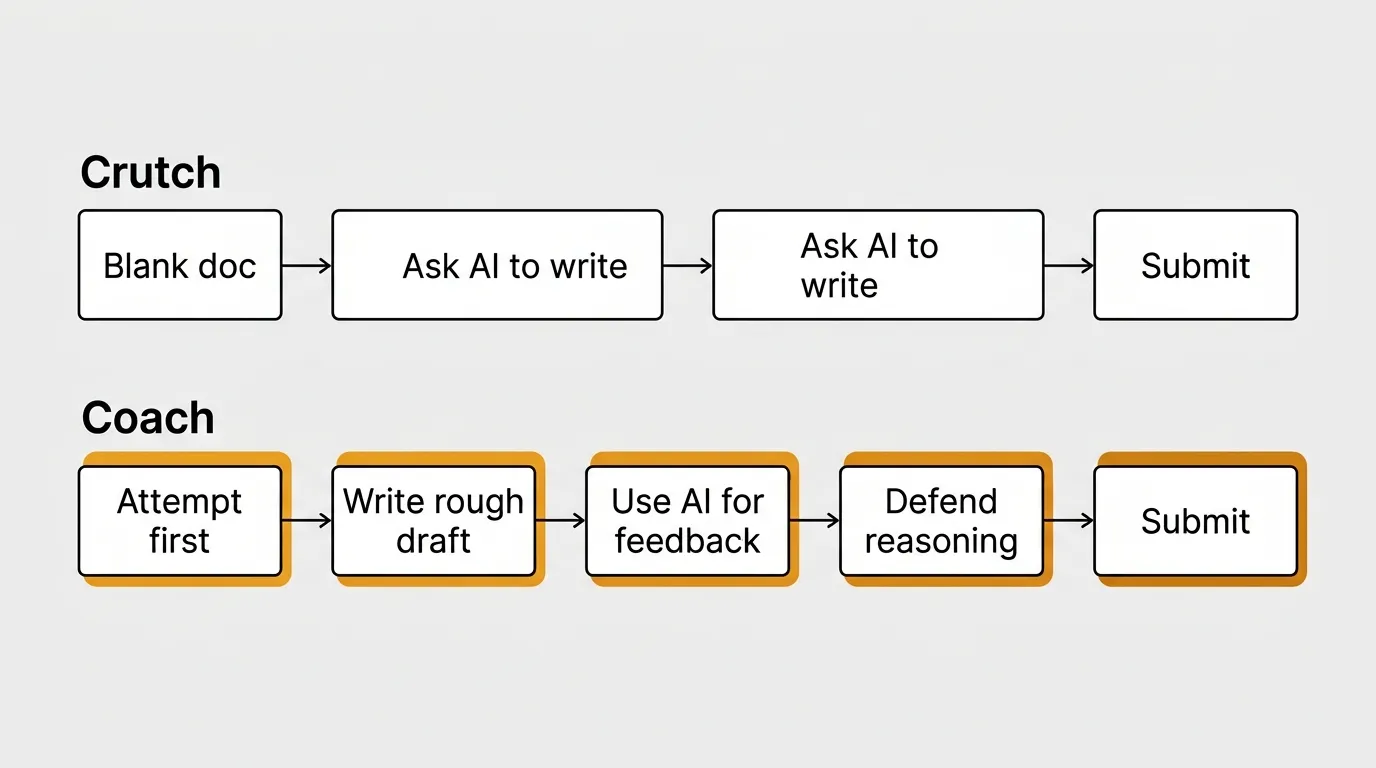
A student who writes a rough draft and then uses AI for feedback is learning. They’re building the argument themselves, then getting a sharp editor. A student who opens a blank document and immediately asks AI to write it has skipped the entire point. The output might be excellent. But their brain did almost nothing, and nothing is exactly what stays with them.
This is what educators can actually change: the sequence. Make it explicit in how assignments are designed. Assess drafts. Ask students to defend their reasoning out loud. Ask them what changed between their first attempt and their final version, and why. These questions are nearly impossible to outsource because they require genuine reflection — something AI cannot fake convincingly, and that a teacher can probe with a single follow-up question.
The best assignments I’ve seen people describe in the AI era are ones that require something unmistakably personal. Not “write an essay on climate change” — but “describe a moment when your understanding of this issue shifted, and what shifted it.” Not “solve this problem” — but “explain what you got wrong on your first attempt and what that taught you.” AI can generate answers to the first kind. It cannot answer the second kind honestly.
Experiential learning matters more now, not less. Debates, real projects, design challenges, labs — these build the capabilities that AI cannot replicate. And they create the kind of moments that actually stick. The education that changes who you are doesn’t happen on a keyboard. It happens in the friction.
And one more thing: students should be taught what AI actually is — where it’s confidently wrong, what it cannot know, when not to trust it. That’s not a warning label. That’s a literacy. It belongs in the curriculum.
The Bigger Picture
I work with AI every day. I’ve watched it transform how engineers work, how analysts think, how writers iterate. I’ve seen what happens when people use it well — and what happens when people use it as a crutch.
The best use of AI is always the same: the human brings the judgment, the taste, the experience, the values — and AI amplifies execution. I’ve written about what this looks like in professional contexts in What AI-Native Actually Looks Like — the principle is the same whether you’re building enterprise systems or teaching a classroom. I’ve also looked at how this same pattern plays out in the workplace — and why it risks turning professionals into AI operators rather than problem solvers — in AI Eliminates One Kind of Monotony — and Quietly Introduces Another. The worst use is always the same too: the human outsources the thinking and rubber-stamps the output.
Education’s job is to develop humans who can do the former. To build the judgment, the taste, the experience — the things AI cannot provide and cannot replace.
If we use the next ten years optimizing for impressive-looking student output, we will fail at that. We will produce capable users of AI who lack the depth of independent thought to direct it well.
If we use the next ten years redesigning learning around genuine human development — with AI as a coach and collaborator, not a substitute — we will produce something rarer: people who can think, create, and lead, and who happen to be extraordinarily good at using AI to do even more.
The goal should not be to create students who can use AI.
The goal should be to create students who can think independently, create originally — and then use AI to do even greater things.
Because the future belongs neither to humans who refuse AI nor to students who let AI think for them.
It belongs to those who can do both.
What is your school or institution doing to redesign assessment for the AI era? I’d like to hear what’s working — and what isn’t.