
Does Grounding Reduce Token Usage? It Depends.
Part 3 of the AI and Token Economics series. Part 1 covered what you’re actually paying for. Part 2 covered five per-turn optimization techniques. This part addresses the most common follow-up question: does grounding the model keep it focused and reduce costs?
The short answer: grounding typically improves accuracy — when the supplied context is relevant and trustworthy. Whether it reduces token usage depends entirely on how you implement it.
The misconception is easy to understand: grounded prompts often produce shorter, more accurate responses. Observers see better outputs and assume fewer tokens were used. In reality, token economics depend on two forces that often move in opposite directions — the context you add and the generation you avoid. Getting both right is the actual challenge.
Key Takeaways
- The assumption: Grounding prompts focus the model, so they must reduce token consumption
- The reality: Grounding is primarily an accuracy technique — token reduction is a conditional side effect
- What you’ll learn: Three scenarios where grounding helps, hurts, or is neutral on token usage — and the pattern that gets you both accuracy and efficiency
What Grounding Actually Is
Grounding means giving the model relevant context, constraints, or rules before asking it to answer. Four common forms:
- Knowledge base excerpt — a passage from documentation or a policy
- Business rules — constraints on what the model can and cannot say
- Role + objective — who the model is acting as and what it’s optimising for
- RAG injection — retrieved document chunks relevant to the query
What grounding does to the model’s behaviour: it narrows the search space. Instead of generating a broad response that hedges against every possible interpretation, the model can anchor on what you gave it.
One distinction worth making early: retrieval (RAG) is one mechanism for delivering grounding — not a synonym for it. You can ground a model with a hardcoded business rule and never touch a vector database. This matters because the token economics differ significantly depending on which mechanism you use.
Here’s the clearest illustration:
Ungrounded: "Explain our leave policy."
→ Model generates a generic HR response. Accurate to no one.

Grounded:   "Using only the leave policy text below, explain the policy.
             Do not use outside information.
             [leave policy text]"
→ Model stays on-topic. Specific. Correct for your context.
The grounded version is better. But is it cheaper? That depends on what you loaded.
Three Scenarios
Scenario 1: Large context dump → tokens go up
If you add a 10,000-token document to every prompt to “ground” the model:
- Input tokens increase significantly on every call
- If the same document is sent repeatedly across turns, you’re paying for all 10,000 tokens each time
- Output may be more accurate, but total cost goes up — sometimes dramatically
This is the most common grounding mistake. People associate grounding with quality and assume quality is free. It isn’t. A 10,000-token system prompt processed across 100 API calls is 1,000,000 input tokens — before a single question is asked.
Two caveats worth acknowledging: prompt caching can reduce the cost of resending repeated large contexts, but the model still processes that context on first use and context-window pressure remains. And if a large context dump eliminates enough follow-up calls or correction rounds, the total workflow cost can still be net positive — the maths depends on your call volume and error rate. The point isn’t that large context is always wrong; it’s that the token cost is real and should be explicit, not assumed away.
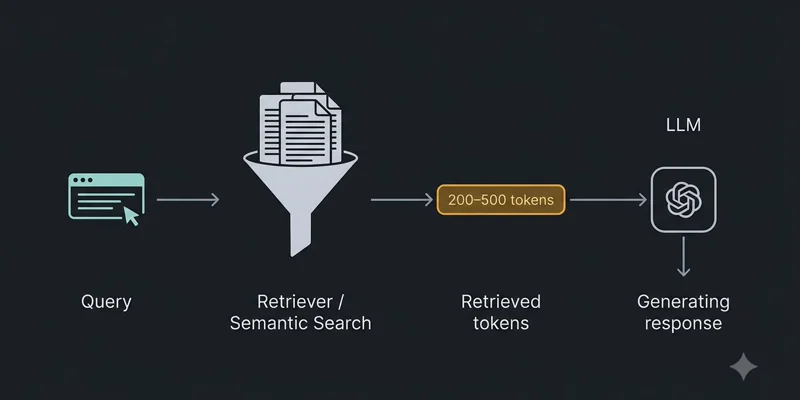
Scenario 2: Retrieval-based grounding (RAG) → tokens may go down
Instead of injecting the whole document, a retriever finds the 200–500 token slice that’s actually relevant to the query:
User query
    ↓
Retriever (semantic search over document store)
    ↓
Inject only the relevant excerpt (200–500 tokens)
    ↓
LLM generates a grounded answer
Compared to either (a) injecting the full document or (b) letting the model hallucinate and triggering follow-up clarification turns, this pattern can meaningfully reduce total token consumption while maintaining accuracy. The savings come from two places: smaller input per call, and fewer correction rounds.
This is the pattern worth building toward if you’re running grounding at scale.
Three office-scenario notebooks show this exact retrieval pattern on real work: Pre-Call Brief, Escalation Calibrator, and Handover Extractor — each injects only the relevant excerpt per query, not the full document set.
Scenario 3: Output constraint instructions → output tokens go down
A different form of grounding — not about what context you inject, but what you instruct the model to do with it:
"Answer in 3 bullet points. Use only the supplied data. Maximum 100 words."
Instructions like these reduce output length and eliminate the hedging and over-explanation that an unconstrained model generates by default. Output tokens are usually more expensive than input, so this is often the highest-leverage grounding change available — especially when the context itself is small.
The same output-constraint mechanism is what makes AI guardrails work: in AI Guardrails in Action, output constraints enforce safe content policies and prevent hallucination — same pattern, different purpose.
Two notebooks show output constraints at work: Budget Variance Narrator — constrains financial commentary to named causes, not vague hedging — and Change Communication Drafter — constrains output to pre-emptive answers, not a generic announcement.
The Failure Modes
Over-grounding: Injecting large payloads that dwarf the actual useful content. A 50,000-token knowledge base where only 500 tokens are ever relevant per query. Cost goes up; accuracy gain is marginal.
Under-grounding: Defining the role but not the output scope. “You are a helpful HR assistant” narrows the persona but leaves output format completely open — the model still generates long, hedged responses. Incomplete grounding captures only part of the available token savings.
Wrong-layer grounding: Constraining what the model knows (context injection) but not what it should do with it (output instructions), or vice versa. Both layers working together is what produces both accuracy and efficiency.
The Practical Rule
Grounding is primarily an accuracy and relevance technique. Token reduction is a possible side benefit — but only when grounding is selective and retrieval-driven.
| Grounding type | Accuracy | Token impact |
|---|---|---|
| Full document injection | High | Tokens go up |
| RAG (relevant excerpt only) | High | Tokens may go down |
| Output constraints | Moderate | Tokens go down (output side) |
| RAG + output constraints | Highest | Best efficiency |
If you’re choosing grounding to reduce costs, the question to ask is: what’s the smallest amount of context that gives the model what it actually needs to answer correctly? That’s the retrieval problem, not the grounding problem. Grounding shapes what the model does with context; retrieval controls how much context it gets.
Hands-On: Build It Yourself
🛠️ Build a Self-Evolving RAG Knowledge Base — 15 Minutes in Colab
Scenario 2 is worth experiencing end-to-end, not just reading about. This notebook builds a minimal IT self-help RAG knowledge base from scratch: seed it with your team’s procedures, query it in natural language, add new knowledge at runtime without retraining, and observe the graceful “not in KB” fallback when the system genuinely doesn’t know — no hallucinated procedures.
It uses ChromaDB (in-memory for the POC, one-line swap to persist it locally or on Cloud) and a free sentence-transformer embedding model that runs entirely in Colab — no paid API key for retrieval, only for generation. The notebook ends with a “where to take this next” table covering chunking strategy, metadata filtering, multi-format ingestion, and the self-updating loop that makes the knowledge base compound over time. Fork it and build your own.
The five office-scenario notebooks linked in the sections above cover the same retrieval and output-constraint patterns applied to everyday work — meeting prep, escalation triage, budget commentary, handovers, and change communications. Each runs in under 5 minutes with a free Groq API key.
Before You Close This Tab
Three questions worth sitting with:
-
What just clicked? Think about a grounded prompt you use regularly — knowledge base, system prompt, document injection. Which scenario does it fall into, and is the token impact what you assumed?
-
Where will you apply this? If you’re currently injecting large context to improve accuracy, is retrieval a viable alternative — and what would the retrieval problem actually look like for your use case?
-
How will you measure it? Accuracy without token measurement is an incomplete picture. What would you track to know whether your grounding strategy is efficient, not just effective?