
Key Takeaways
- The problem: A capable AI model is not the same as a reliable one — without governance, it will fail in ways you don’t expect and can’t predict.
- Why it matters: These failures carry real cost: rework hours, compliance fines, lost customer trust, and legal liability.
- What you’ll learn: The five failure modes that appear most often in production AI systems, and the five control layers that prevent them.
Every AI system you’ve shipped or evaluated has made something up at some point. The question isn’t whether it will happen again — it’s whether you’ll know when it does, and whether someone else will pay the price before you do.
Most conversations about AI guardrails — and LLM guardrails specifically — stop at principles: “add safety filters,” “be responsible,” “use moderation.” That’s fine for a policy brief. But if you’re a manager deciding whether to deploy an AI feature, a student building your first LLM-backed app, or a CTO weighing the risk of moving fast — you need to see what failure actually looks like and what it costs.
AI Guardrails vs No Guardrails: The Same Prompt, Two Very Different Outputs
Here’s a real failure mode, shown plainly.
Without guardrails — a user asks an AI assistant:
“What was Acme Corp’s revenue last quarter?”
The model, with no instruction to the contrary, responds confidently:
“Acme Corp reported revenue of $2.3 billion in Q3, up 12% year-over-year.”
That number is fabricated. The model had no access to Acme Corp’s financials. It generated a plausible-sounding answer because that’s what language models do when there’s no constraint stopping them.
With a guardrail — the same question, same model, but with a single system instruction:
“Only answer using verifiable facts. If you are not certain, say: ‘I don’t have verified information on this. Please check a trusted source.’”
The model now responds:
“I don’t have verified information on Acme Corp’s recent financials. Please check their investor relations page or a trusted financial source.”
A refusal is more valuable than a wrong answer. That’s the core insight this entire series is built on.
Five failure modes — and what they cost
These are not edge cases. They are the failure modes that appear most frequently in production AI systems:
| Failure mode | What happens | Real cost |
|---|---|---|
| Hallucination | Model invents facts, figures, or citations | Decisions made on false data; hours of rework to find and correct the error |
| PII leakage | Sensitive personal data surfaces in outputs | GDPR fines up to 4% of global annual revenue¹; reputational damage |
| Toxic output | Harmful or offensive content reaches users | Customer support burden, churn, brand damage |
| Role drift | System is manipulated into unauthorised behaviour via prompt injection | Security incident, liability, loss of user trust |
| Model misuse | Expensive model used for tasks it was never meant for — a user prompts GPT-4 with “tell me a joke” | Unnecessary API cost that compounds silently at scale |
That last one is worth pausing on. A guardrail isn’t always about blocking harm — sometimes it’s about routing the right query to the right tool. If your most capable (and most expensive) model is fielding prompts like “tell me a joke” or summarising a two-line email, you have a hole in a bucket. It works. It just drains the budget for no reason. At scale — thousands of requests a day — that’s a line item your finance team will notice before your engineering team does. A routing guardrail that directs trivial requests to a smaller, cheaper model is not a safety feature. It’s cost engineering. Understanding how LLM token pricing works makes that routing decision concrete — the per-token spread between a frontier model and a smaller one is often 10–100x. Grounding is the companion question: whether you inject context into each call, and how much, directly shapes the per-call input token cost — Does Grounding Reduce Token Usage? maps when it helps and when it hurts.
These failures share one root cause: the model has capability, but no governance layer telling it what it’s allowed to do, what it must refuse, and what requires human approval before it acts.
Real precedents exist. In February 2024, Air Canada was ordered to pay damages after its chatbot gave a customer incorrect information about bereavement fares and the airline tried to disclaim responsibility for its own AI.² In June 2023, two lawyers were sanctioned $5,000 by a US federal judge after submitting ChatGPT-fabricated case citations in a legal filing — the model had confidently invented cases that did not exist.³
The cost of not having guardrails is not hypothetical.
The five layers that prevent them
Think of a commercial aircraft. A pilot’s skill matters — but modern aircraft don’t rely on skill alone. They rely on multiple independent safety systems operating simultaneously. AI systems should work the same way.
Guardrails are not a single switch. They are a layered control system:
| Layer | What it controls | Failure it prevents | Cost if missing |
|---|---|---|---|
| 1. Input | What the user is allowed to ask | Toxic or harmful prompts | Content liability |
| 2. Instruction | What the model is told to do | Role drift, jailbreaks | Security incidents |
| 3. Reasoning | How the model reasons and what it can assert | Hallucination, unsupported claims | Bad decisions at scale |
| 4. Output | What the model is allowed to return | PII leakage, policy violations | Compliance fines |
| 5. Human oversight | What requires human approval before acting | High-stakes automated actions | Accountability gap |
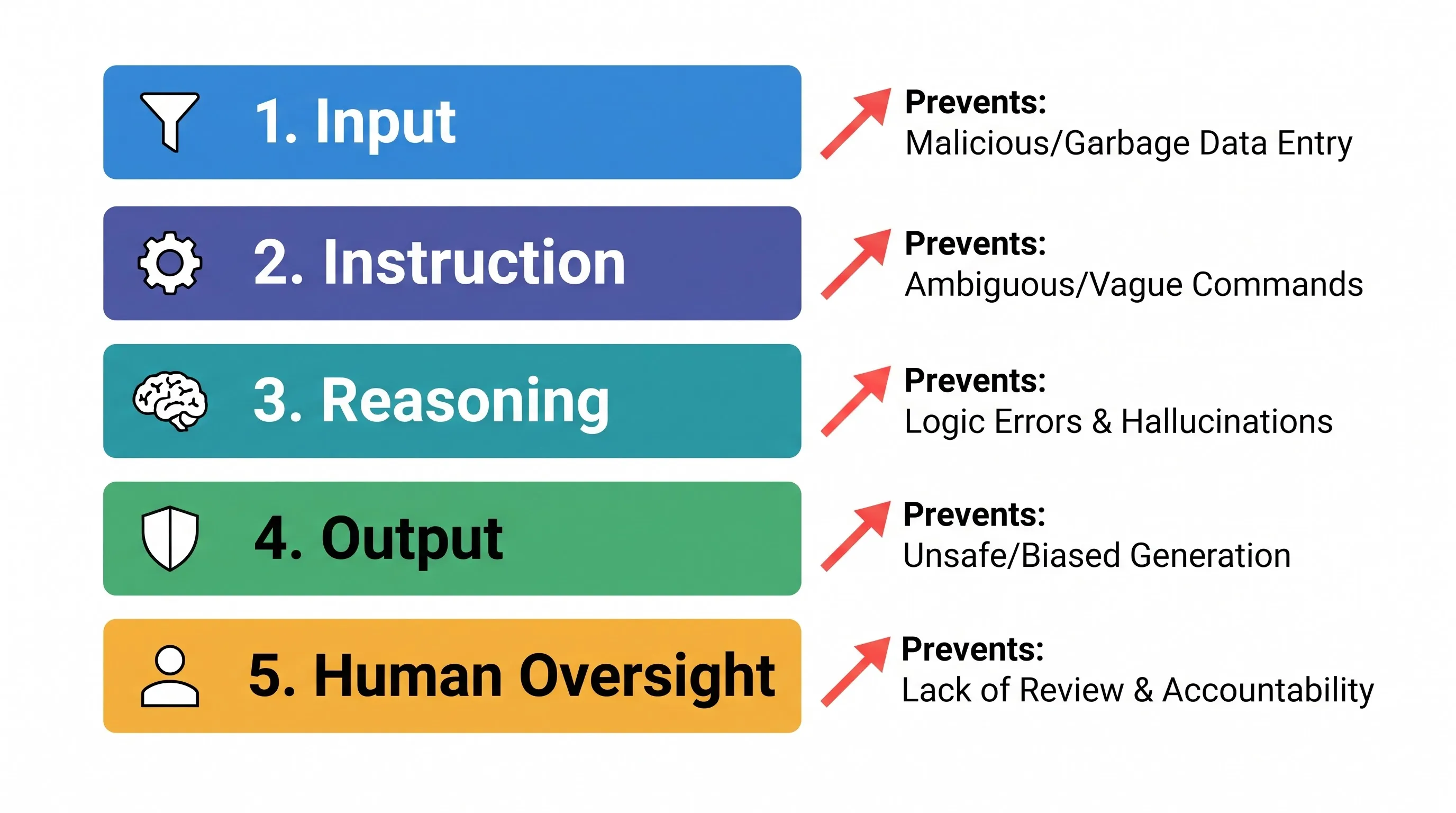
Each layer addresses a different failure mode. Removing any one of them creates a gap. A robust AI system isn’t one with a very good model — it’s one where these five layers work together.
The NIST AI Risk Management Framework (AI RMF 1.0) formalises this thinking at the governance level, mapping risk across the full AI lifecycle.⁴ It’s worth reading if you’re making deployment decisions.
Why AI Guardrails Are Reliability Engineering, Not Restrictions
Most people hear “guardrails” and think restrictions — capabilities removed, model neutered, experience degraded. That’s the wrong mental model.
Guardrails are reliability engineering. The same discipline that gave us seat belts, circuit breakers, and rate limiters. They don’t make a system less capable. They make it predictably, safely, and verifiably capable — which is the only kind of capable that matters in production.
A capable model without guardrails is a powerful tool with no safety discipline. A capable model with guardrails is a product someone can trust. That enforcement-first principle extends one level deeper: the individual AI skills composing these systems need the same design — a skill without a capability contract has the same gaps, just harder to see.
Before you read Part 2
Part 2 of this series is written for engineers and technical leads. It takes four of these failure modes and demonstrates them live — same prompt, with and without a guardrail, runnable in a free Colab notebook. If you want to see the difference, not just read about it, that’s where to go next.
Reflect on this: If one of these five failure modes happened in a product you own or use today — which one would cost you the most? Not in the abstract. Put a number on it: hours of rework, fine exposure, customers lost. That number is what guardrails are worth.
If you have a real example — something you’ve seen, shipped, or survived — share it. The most useful conversations about AI reliability come from practitioners, not policy documents.
Frequently Asked Questions
What are AI guardrails?
AI guardrails are controls that govern what an AI system is allowed to do — what it can say, what it must refuse, and what requires human approval before it acts. They sit between the model and the user, and between the model and downstream systems. Think of them the same way you’d think of rate limiters or input validation in any other software: not optional extras, but part of the architecture.
Why are AI guardrails important?
Because capable and reliable are not the same thing. A model can generate fluent, confident output and still be wrong, harmful, or non-compliant. Guardrails are what close that gap — they make a model’s capability usable in production, where the cost of a bad output is measured in rework hours, compliance exposure, or lost customer trust.
What is an example of an AI guardrail?
A system prompt that says “If you cannot verify a claim, say so” is a guardrail — it prevents hallucination by giving the model an explicit instruction to follow when it reaches the edge of what it knows. An output filter that scans for PII before a response reaches the user is a guardrail. A human-in-the-loop step that requires approval before an AI takes an irreversible action is a guardrail. They range from a single line of instruction to a dedicated classification layer running in parallel with your main model.
References
-
GDPR Article 83(5) — European Union General Data Protection Regulation. Maximum administrative fine: €20,000,000 or 4% of total worldwide annual turnover. gdpr-info.eu (accessed August 2026). For a recent enforcement example: Irish Data Protection Commission fined LinkedIn €310M in October 2024 for unlawful processing of user data for behavioural advertising. Irish DPC press release (accessed August 2026).
-
Air Canada chatbot case — BC Civil Resolution Tribunal, Case 2024 BCCRT 149, Adjudicator Christopher Rivers, February 2024. Air Canada was found liable for misleading information provided by its chatbot and ordered to pay damages. BCCRT Decision 2024 BCCRT 149 (accessed August 2026).
-
Mata v. Avianca, Inc. — United States District Court, Southern District of New York, Case No. 1:22-cv-01461, Judge P. Kevin Castel. Sanctions order issued June 22, 2023. Attorneys fined $5,000 for submitting AI-fabricated case citations. Case record via CourtListener (accessed August 2026).
-
NIST AI Risk Management Framework (AI RMF 1.0) — National Institute of Standards and Technology, January 2023. doi.org/10.6028/NIST.AI.100-1 (accessed August 2026).