Key Takeaways
- The problem: “AI-native” appears on strategy decks, job postings, and board updates — but nobody defines it. A vague destination is convenient because transformation never officially fails.
- Why it matters: The gap between running AI and being AI-native is almost never a model problem — it’s a systems problem: data architecture, cognitive debt, platform assumptions, governance, agent design.
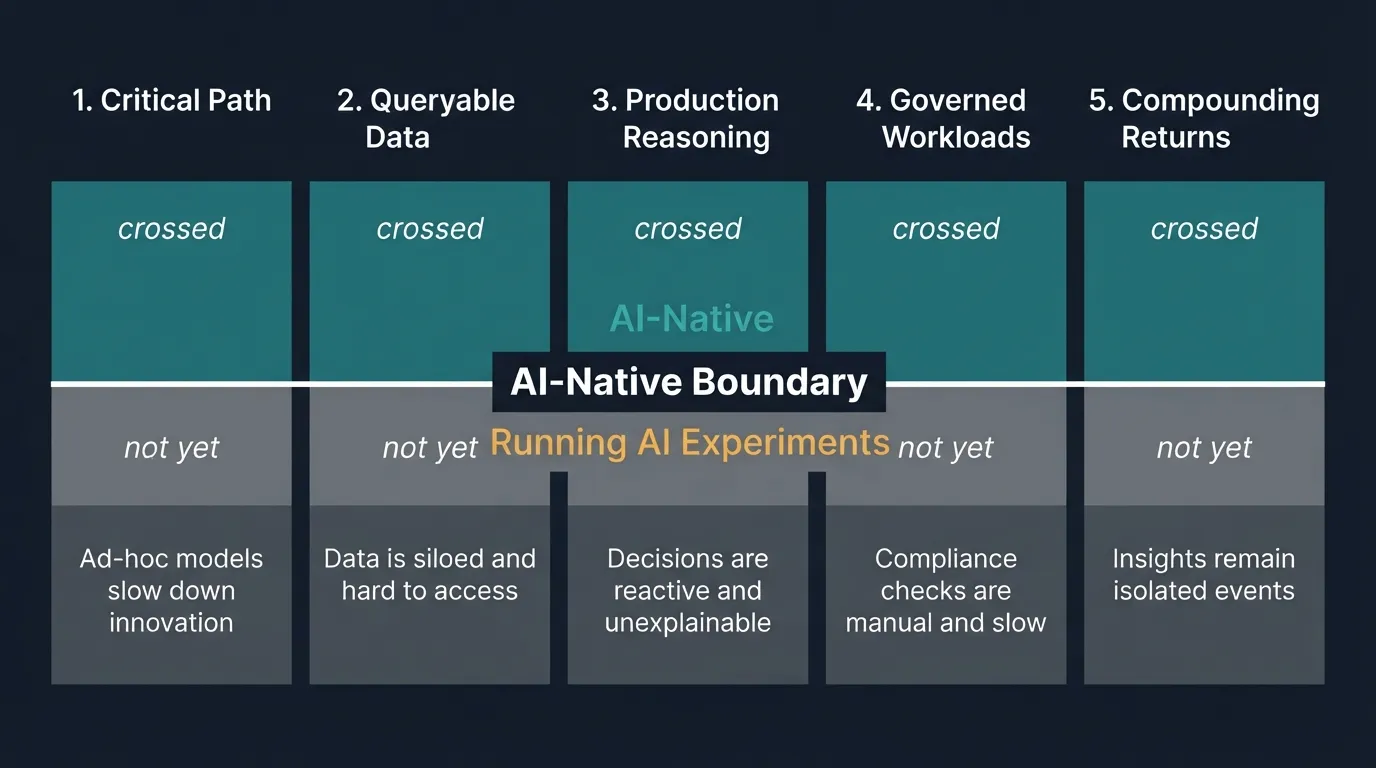
- What you’ll learn: Five operational characteristics that define a binary boundary condition — not a maturity scale — separating an AI-native organization from one that’s running AI experiments indefinitely.
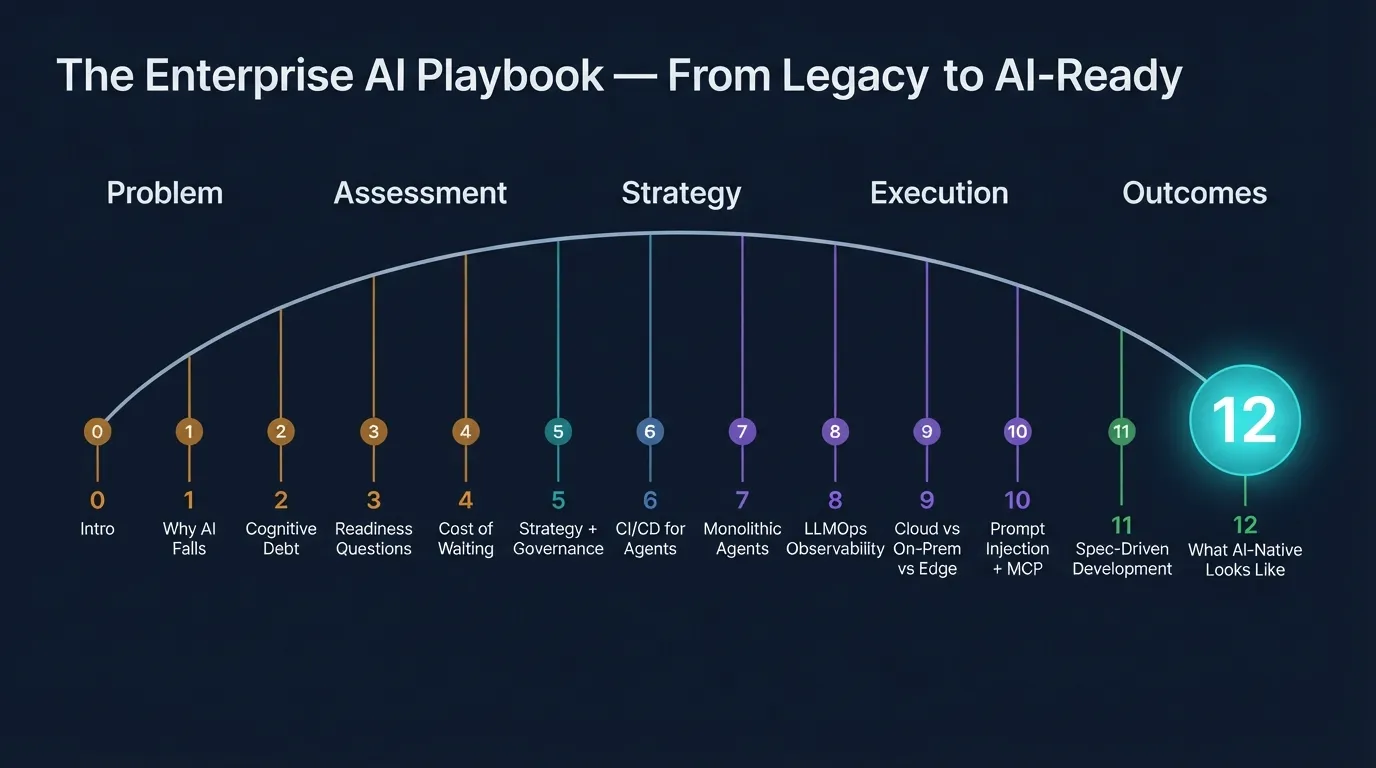
Eleven posts into this series, we’ve covered the problems, the debt, the strategy, the platform gaps, the architecture decisions, the governance primitives, and the deployment tradeoffs. Every one of those conversations eventually circles back to the same unstated question: what are we actually trying to become?
I’ve been in roadmap reviews where “become AI-native” appeared as a Q3 objective, and in hiring discussions where it appeared in the job title. In both cases, when I asked what it actually meant, the answer was usually some version of “use AI tools across the team.” That’s a reasonable starting point — but it’s not the destination. The teams that struggle most with AI aren’t the ones who haven’t adopted the tools. They’re the ones whose underlying infrastructure was never opened up in a way that makes those tools reliable or safe to build on. Adopting AI on top of closed, fragile data systems doesn’t make you AI-native. It makes you dependent on AI in ways you can’t yet reason about or govern.
“AI-native” is everywhere. It’s on strategy decks, job postings, vendor pitches, and board updates. Nobody defines it. That’s not an accident — a vague destination is convenient. Without a finish line, transformation never officially fails — which is exactly how some organisations prefer it.
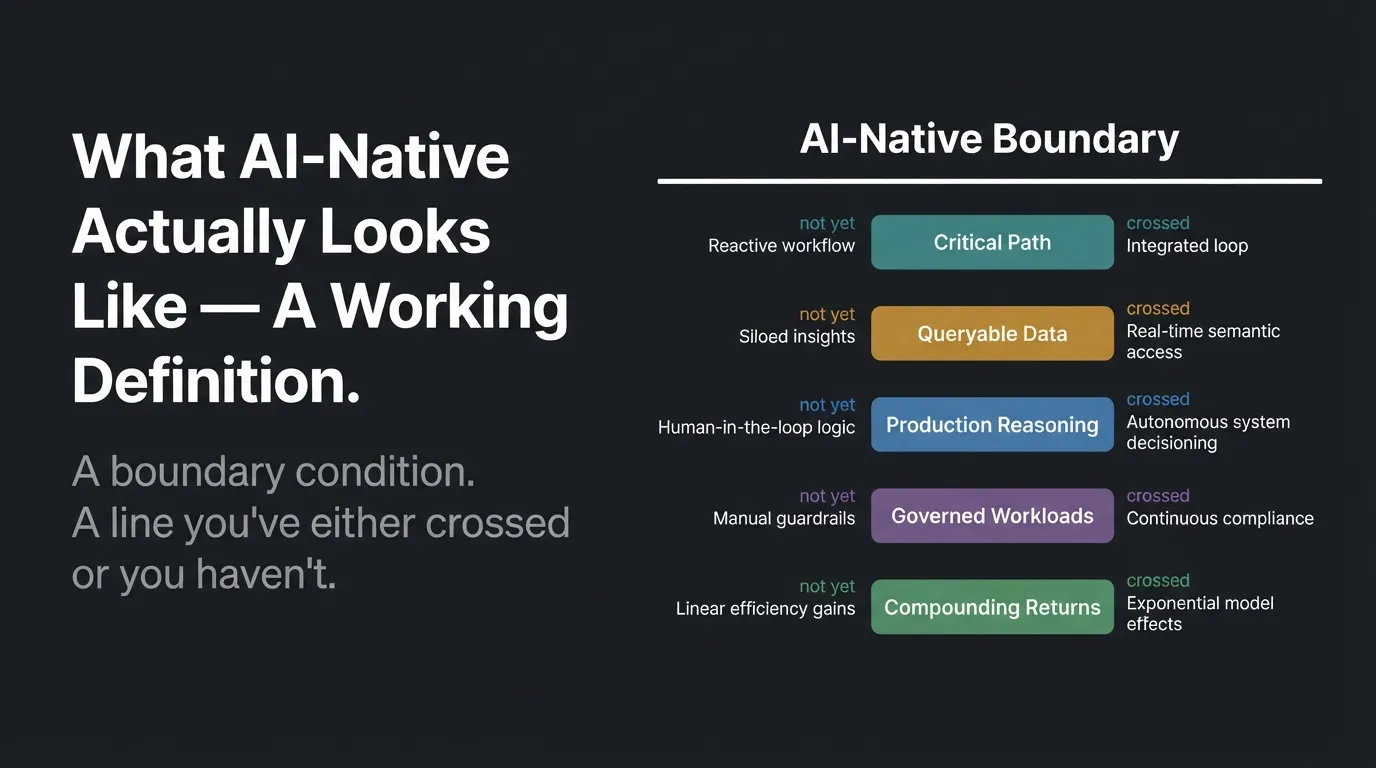
This post is an attempt to fix that. Not a maturity model — those describe a spectrum you’re perpetually moving along, which is just “vague destination” with more steps. What follows is a boundary condition. A line you’ve either crossed or you haven’t. Five operational characteristics that separate an AI-native organization from one that’s running AI experiments.
A maturity model says you’re always somewhere on the scale. A boundary condition says the question is binary: have you crossed it or not? Maturity models are useful for progress tracking. A boundary condition is useful for honest diagnosis — it forces the question “which of these do we not have?” rather than “how far along are we?” Those are very different conversations.
The Five Characteristics
1. AI is in the critical path — not advisory, not experimental
This is the clearest signal and the hardest to fake.
Advisory AI: a dashboard that surfaces insights a human may or may not act on. Experimental AI: a pilot that runs in parallel with the real process. Neither of those is AI-native. They’re hedges.
AI-native means at least one core operation — a process that the business depends on — runs through AI, not alongside it. The model isn’t a recommendation engine for a human decision. It’s load-bearing. If it goes down, the operation degrades. That’s when the organization has genuine skin in the game — and genuine incentive to get observability, reliability, and governance right.
2. Data is designed to be queried, not just stored
The data architecture conversation happened. That’s what this characteristic is really measuring.
AI-native organizations don’t just have data — they have data that was deliberately structured to be accessible, contextual, and joinable across systems. Schemas were designed with retrieval in mind. Context is attached, not assumed — that’s not a design detail, it’s a design decision. Data contracts exist so that AI outputs don’t silently drift when an upstream schema changes.
The organizations that haven’t crossed this line are easy to spot: their AI pilots perform well in demos and degrade in production. The model isn’t the problem. The data was never built to answer questions — it was built to record transactions.
3. The team can reason about AI behavior in production
This one is about cognitive debt — the accumulating opacity that comes from deploying AI without building the vocabulary to understand it.
An AI-native organization can answer these questions without heroics: Why did the model respond that way? Can a non-author debug a production incident without calling the original builder? Where is the system drifting, and how fast? What does a production incident look like, and who owns it?
If the only people who can answer those questions are the model vendors or a single engineer who built the original integration, you haven’t crossed this line. Observability isn’t just dashboards — it’s organizational fluency. The team has to be able to reason about the system, not just deploy it.
4. AI workloads are governed, not just deployed
Governance that requires heroics isn’t governance — it’s theater that happens to occasionally work.
AI-native organizations have a repeatable process. The AI BOM exists — model versions tracked, data flows documented, failure modes stated upfront (see Post 5 for the full AI BOM structure). A governance reviewer can evaluate a new AI deployment quickly not because the bar is low, but because the artifact arriving for review is actually legible.
The test: if the engineer who built the system left tomorrow, could the organization understand what’s running, why, and what it touches? If the answer is “probably not,” governance is person-dependent — which means it isn’t governance.
5. The system evolves faster with AI than without
This is the one that closes the loop.
One-time AI wins are not transformation. If the organization built something impressive in Q1 and is still running on that same capability in Q4 with no meaningful evolution, what happened was a project, not a transformation. AI-native operations have a compounding characteristic: the system gets better as it runs, the team gets better at building for it, and each iteration is cheaper and faster than the last.
If adding a new AI capability still requires the same multi-quarter procurement and integration cycle that the first one did, the organization has shipped AI but hasn’t become AI-native. The transformation should be delivering compound returns, not single instances.
A useful proxy: how long did your second AI capability take to ship compared to your first? If the answer is “about the same,” the compounding hasn’t started yet.
Using This as a Decision Lens
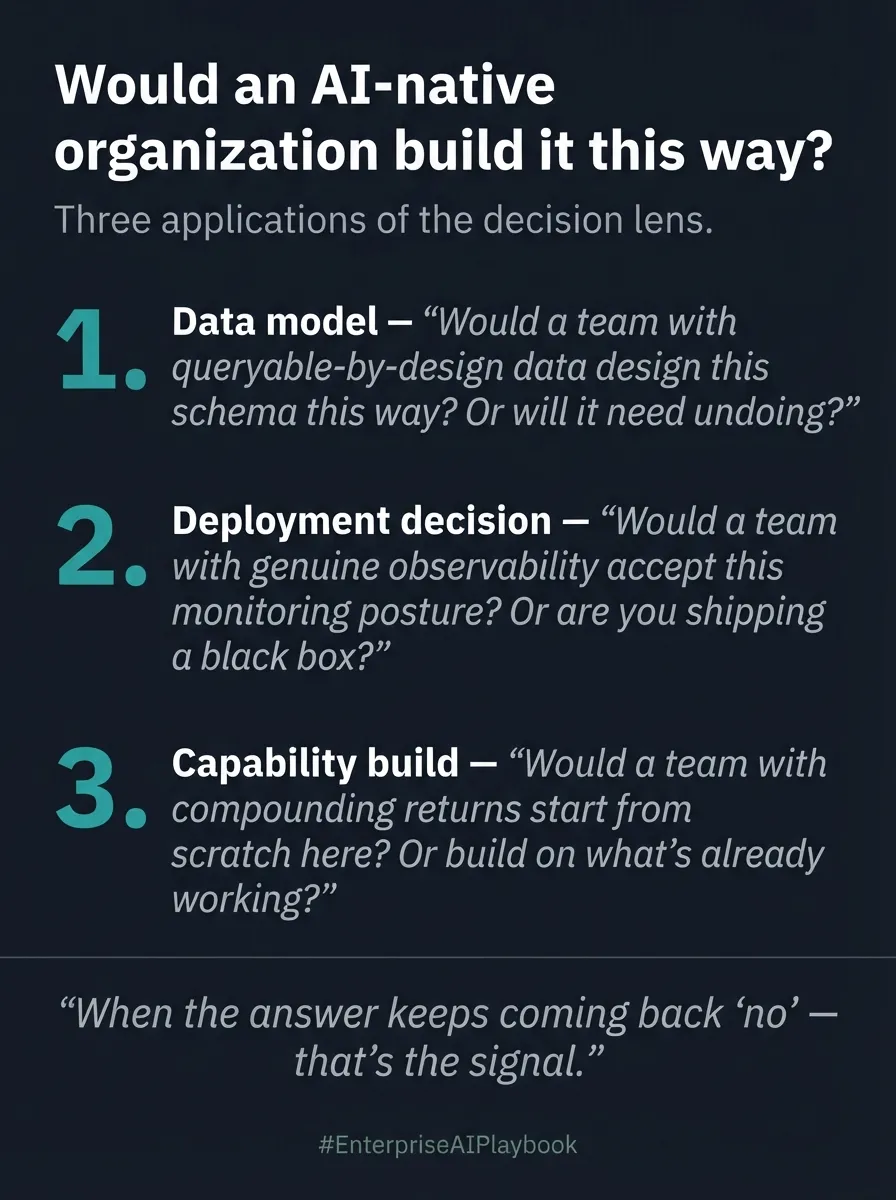
These five characteristics are also useful as a filter for forward decisions — features, architecture patterns, hires. Ask: Would an AI-native organization build it this way?
Three concrete applications:
- Evaluating a data model: Would a team with queryable-by-design data design this schema this way — or are you building something that will need to be undone when retrieval becomes load-bearing?
- Evaluating a deployment decision: Would a team with genuine production observability accept this monitoring posture — or are you shipping a black box and hoping it behaves?
- Evaluating a capability build: Would a team with compounding returns need to start from scratch here — or does the work build on infrastructure that’s already earning its keep?
The question isn’t rhetorical. It’s a calibration tool. When the answer keeps coming back “no” — when every new decision requires the same foundational work that should already be done — that’s a signal about where you actually are on the boundary, not where the strategy deck says you are.
To ground your honest self-assessment, compare these five characteristics against the structural diagnostic from earlier in the series: 5 Questions That Reveal Whether Your System Is Actually Ready for AI. The questions are different, but they map to the same underlying gaps — and the answers tend to agree.
What This Series Was Actually About
Looking back at all twelve posts, there’s a through-line that wasn’t stated explicitly at the start: the gap between running AI and being AI-native is almost never a model problem. It’s a systems problem. Data architecture. Cognitive debt. Platform assumptions. Governance primitives. Agent design. Deployment decisions.
The model is usually the easiest part. The organization is the hard part.
Every post in this series named one layer of that hard part. The point was never to prescribe a universal playbook — enterprise contexts are too different for that. The point was to give you the vocabulary to see your own situation clearly, and a set of questions sharp enough to cut through the comfortable ambiguity of “we’re on the journey.”
You’re either AI-native or you’re not yet. That’s a more useful frame than a maturity model, because it forces a specific question: which of these five characteristics do you not have, and what would it actually take to get there?
That’s the conversation worth having — and it’s one where a clear definition of the destination changes everything.
Ready to review the full journey — from the original diagnosis to this finish line? The Enterprise AI Playbook — Why I’m Writing This is where the arc starts.
If this series raised questions worth continuing, or if you’re working through one of these problems and want to think out loud about it — find me on LinkedIn. The next chapter is already running — and the problems are getting more interesting.
→ Share your own definition of AI-native. I want to know where you’d draw the line differently.