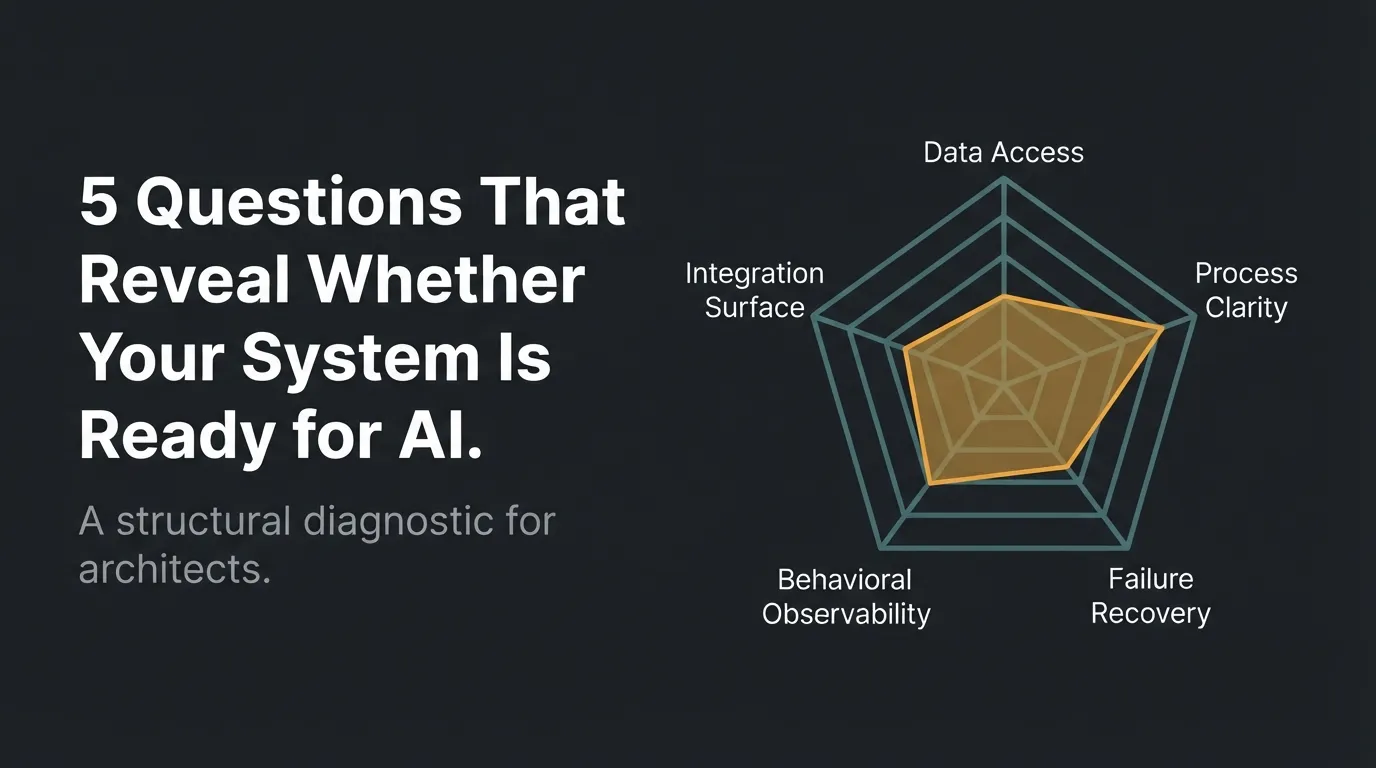
Key Takeaways
- The problem: AI readiness checklists measure features, not fitness — a system can have every modern component and still fail structurally when AI is wrong and the system can’t catch, contain, or recover from it.
- Why it matters: The failures don’t show up in setup. They show up in production — and by then, the load-bearing weaknesses were present from the start.
- What you’ll learn: Five structural diagnostic questions for architects that surface exactly where AI will accelerate your system or collapse it — before the pilot starts.
Most AI readiness assessments are checklists. Do you have an API layer? A vector store? An LLM gateway? Check, check, check — and the system still fails three weeks into the pilot.
The checklist passes because it’s measuring features, not fitness. A system can have every modern component and still be structurally unready for AI. The failures usually don’t show up in setup. They show up when AI is wrong — and the system has no way to catch it, contain it, or recover from it.
Post 2 of this series covered structural exposure — the cognitive debt hiding inside AI-augmented codebases. This post goes one level up: before you touch the code, before you pick a framework, run these five diagnostic questions. They won’t give you green lights and red lights. They’ll show you exactly where AI will either accelerate your system or collapse it.
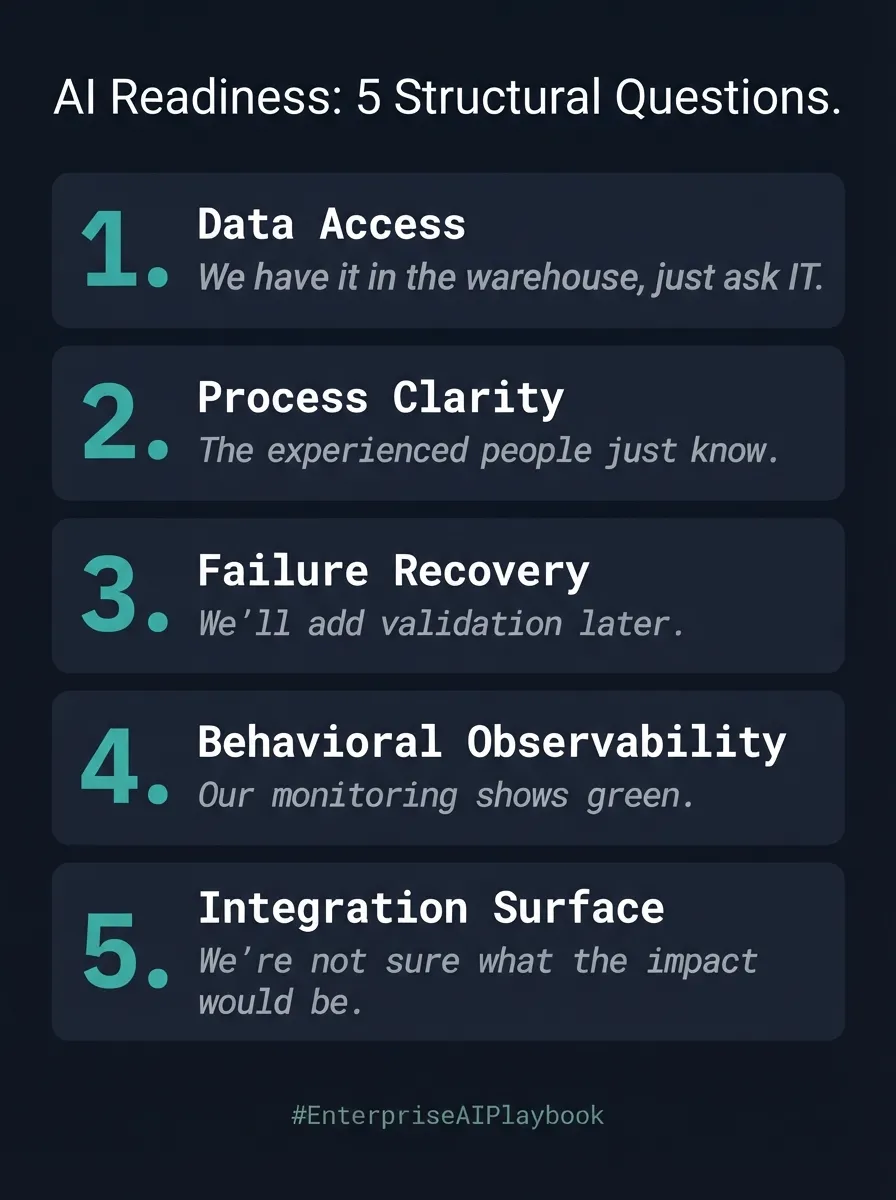
The Diagnostic Framework: 5 Structural Questions
These aren’t survey questions. They’re conversations — the kind that surface the 3–5 integration points that make or break an AI integration before the pilot starts.
The question that consistently triggers the most pushback is Question 4. Teams with solid DevOps practices hear “can you tell if the AI is doing the right thing?” and immediately point to their dashboards — latency, error rates, uptime, all green. What they’re describing is a healthy system. What they haven’t answered is whether it’s a credible one. Those are different questions. A system can be perfectly healthy while quietly giving users answers they can’t trust. The monitoring infrastructure most teams have inherited was built to catch the system going down — not the system being wrong in ways that look right.
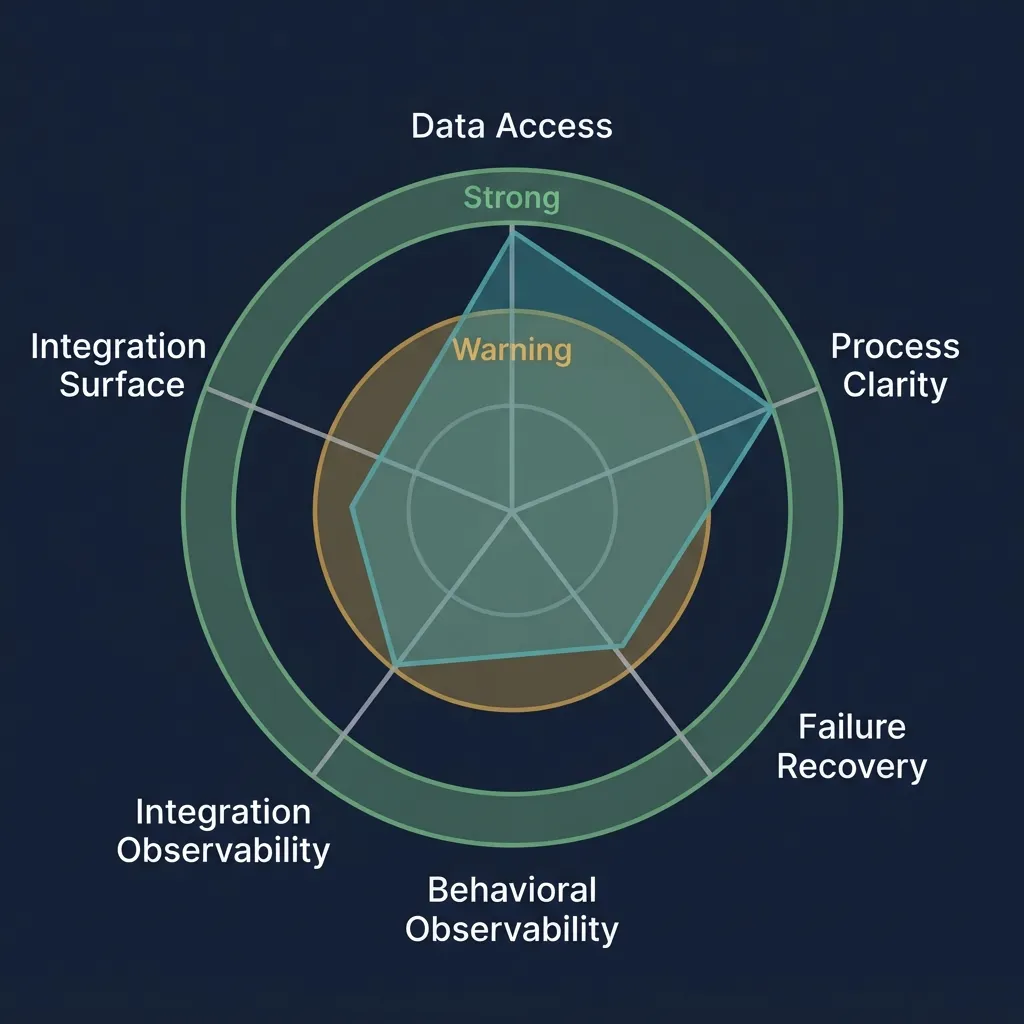
Question 1: Can AI reach what it needs without friction?
What you’re testing: Data accessibility — not just whether data exists, but whether it’s reachable, joinable, and fresh enough to reason over.
Strong answer: The data AI needs has a stable, low-latency access path. Schemas are documented. Cross-system joins don’t require a ticket and a two-week wait. Sensitive data has controlled access that doesn’t require rebuilding a pipeline every time the model needs a new field.
Warning sign: Every new data source requires a project. The team describes their data integration story as “we have everything in the warehouse, you just have to ask IT.” That lag is invisible in demos and fatal in production.
The question to ask your team: “If the AI needed three new data fields from a different system tomorrow, what would that take?” The answer tells you more than any architecture diagram.
Question 2: Are the workflows AI will touch well-defined or ambiguous?
What you’re testing: Process determinism — whether the workflow has enough structure for AI to operate in it reliably.
Strong answer: The workflow has clear inputs, expected outputs, and defined edge cases. Exceptions have documented handling paths. Humans and AI have unambiguous roles: the AI does X, the human decides Y.
Warning sign: The team describes the process as “it depends on judgment” or “the experienced people just know.” That’s not a limitation of the AI — it’s a signal that the process itself isn’t formalized enough to automate safely. Unstructured judgment isn’t something you can hand to a model. You first have to extract and encode it. If you haven’t done that work, the AI will interpolate — and nobody will be able to tell when it gets it wrong.
If your diagnostic is also surfacing questions about where these models should actually run — data residency, latency floors, hosting constraints — don’t let cost dominate that conversation. Cloud, On-Prem, or Edge: The Real Decision Framework for AI Workloads walks through the three variables that actually make that call.
If this diagnostic reveals a single massive agent prompt attempting to handle the entire workflow, that’s worth stopping for. The Case Against the Monolithic Agent explains why that architecture breaks under load — and what the alternative looks like before you write another line of orchestration.
Question 3: What happens when AI is wrong, and can the system recover?
What you’re testing: Failure handling — not just error handling in the technical sense, but operational resilience when the model produces a bad output.
Strong answer: Bad outputs are caught before they propagate. There are human checkpoints for high-stakes decisions. Rollback is possible. The blast radius of a wrong answer is bounded — it affects one order, one record, one downstream step, not the whole pipeline.
Warning sign: The AI’s output feeds directly into an automated action with no review gate. Or: “we’ll add validation later.” Later doesn’t come. This is the question that most architecture reviews skip because the failure mode is downstream and invisible until it isn’t.
The framing that helps here: “Show me the path a wrong AI output takes through the system from generation to consequence.” If nobody can trace that path, the failure handling isn’t designed — it’s assumed.
Question 4: Can you tell the difference between “AI worked” and “AI did the right thing”?
What you’re testing: Observability — specifically the gap between operational correctness (the pipeline ran) and behavioral correctness (the output was good).
Start here: “How would we know if the AI started giving subtly wrong answers six months from now?” If the room goes quiet or the answer is “we’d see it in support tickets eventually” — the observability isn’t there yet.
Strong answer: You have metrics that measure outcome quality, not just system health. There’s a feedback loop that captures whether AI recommendations were acted on, overridden, or quietly ignored. You can detect model drift before it shows up in business outcomes.
Warning sign: The monitoring stack measures latency, error rates, and uptime — the standard stuff. Nobody has defined what “good output” means in measurable terms. A practical example: an AI that summarises support tickets could be producing summaries that miss the customer’s actual complaint — every metric is green, but the support agent is making decisions on incomplete information. This is the most common gap in enterprise AI deployments. Infrastructure observability is table stakes. Behavioral observability requires deliberate design and is almost always absent in the first version.
Question 5: How many systems does this AI touch, and what’s the blast radius of a bad output?
What you’re testing: Integration surface area — the number of systems downstream of the AI, and how tightly coupled they are to its outputs.
Strong answer: The AI operates within a bounded scope. Downstream systems treat AI output as advisory or apply their own validation before acting on it. The integration surface is small enough that failures are localized and diagnosable.
Warning sign: The AI touches many systems, and those systems trust its output without independent validation. Each additional integration point is a potential amplifier for errors. A model that’s right 95% of the time sounds reliable until you realize it’s feeding five downstream systems simultaneously — and the 5% propagates everywhere at once.
The framing: “If this AI produced plausible-but-wrong output for four hours, what would the state of the system look like?” If the answer is “we’re not sure” or “bad,” the integration surface needs to shrink before the AI goes live.
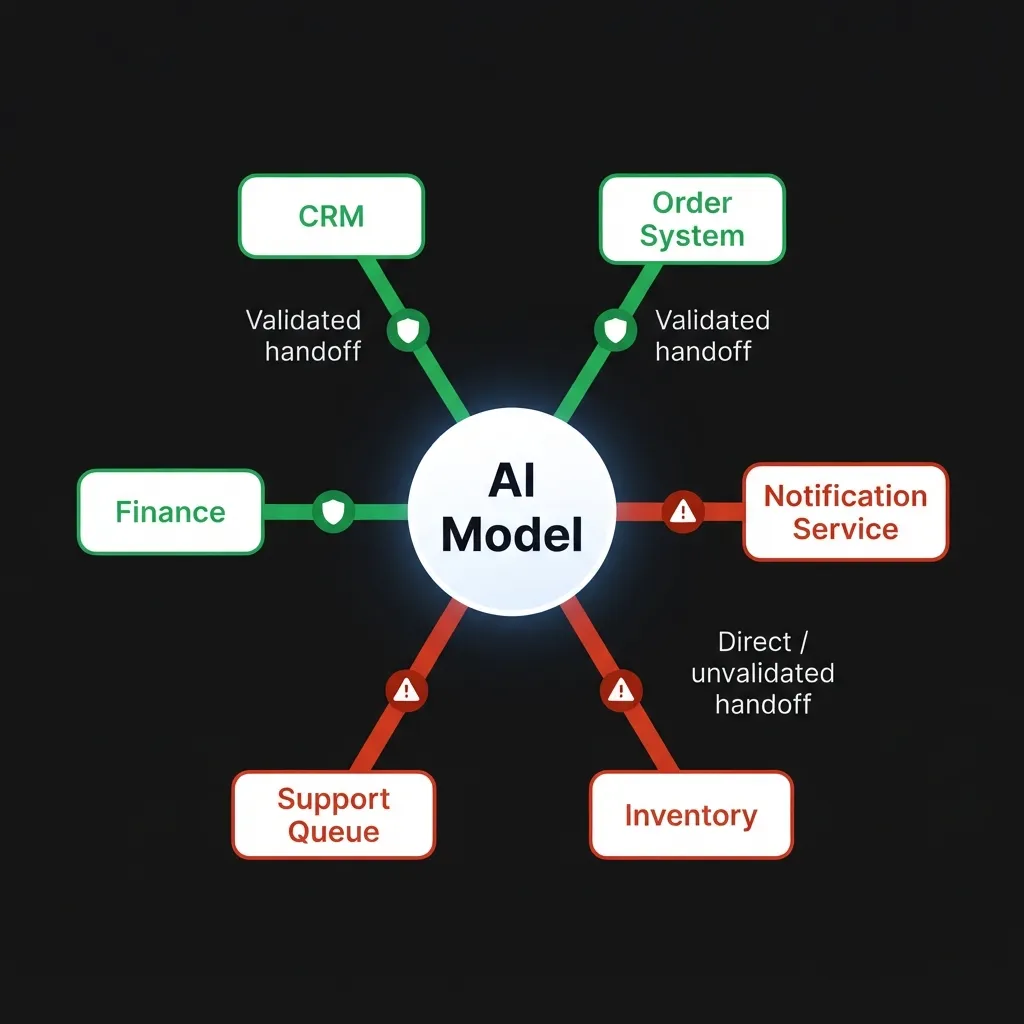
Note for publishing: When an agent has a large integration surface and private data access and external communication capability simultaneously, the risk compounds significantly. Post 10 covers this combination in depth — the trust boundary problem and what practitioners call the lethal trifecta.
How to Use This as an Architect
These five questions aren’t meant to produce a score. They’re meant to produce a map.
After running this diagnostic with the right people — not just the AI team, but the data owners, process owners, and system integrators — you’ll have identified the 3–5 points where the AI integration either holds or breaks. Those are the points to address before the pilot, not after.
Who should be in the room: The AI team is not enough. You need the data owner (who knows where the friction actually lives), the process owner (who can describe what “judgment” actually means in their workflow), and at least one downstream system owner (who can tell you what a wrong AI output actually touches). Without those three, the answers will be optimistic.
How long it takes: 45–90 minutes for a focused workshop. Don’t rush Question 3 (failure handling) — it almost always surfaces implicit risk assumptions that nobody has made explicit. Plan for that question to take twice as long as the others.
When the answer is “we don’t know”: That is an answer. “We don’t know what happens when AI produces a bad output” is not a gap to defer — it’s the most important thing to resolve before the pilot starts. Log it as an explicit open item, assign an owner, and don’t let it stay open.
The value isn’t in the answers. It’s in what surfaces when you ask. Teams that can answer Question 1 quickly usually have data friction they’ve normalized. Teams that struggle with Question 3 usually have implicit risk assumptions nobody has made explicit. The conversation is the diagnostic.
Wherever the room goes quiet or starts describing exceptions — that’s the load-bearing weakness.
The diagnostic shows you where the exposure is. The harder question is what it costs to leave it there. → Post 4: The AI Debt You’re Accumulating Every Sprint You Wait