How Resourceful Is Your AI Skill?
Part 1 of 3 in The Resourceful AI Skill series.
Key Takeaways
- The problem: AI skills are being shipped and consumed like production APIs but built with no more rigour than a prompt snippet.
- Why it matters: The gap between how skills are built and how they behave in production is where token costs spike, behavior breaks, and security holes open.
- What you’ll learn: Through the story of a skill I published myself, the three failure modes that show up most consistently — and a maturity model to calibrate where yours stands today.
While building open-skills, my personal AI skill library, I kept seeing the same patterns in the community: cloned prompts under new names, no input or output schemas, no test coverage, permission scopes borrowed from more capable skills and never trimmed. Publishing was near-zero friction. Quality signal was near-zero.
I was aware enough to see the gap in others’ work. What took longer to admit was that my own published skills had the same gaps.
So let me show it honestly through profile-bio — a skill I built, published, and use.
The Skill
profile-bio guides you through an 8-question interview — name, platforms, what you do, core belief, personal texture, tone, CTA, links — then generates ready-to-paste bios for up to 6 platforms: Twitter/X, LinkedIn, YouTube, Reddit, Instagram, and GitHub. Each output respects the platform’s character limits and tone conventions. It also has an assets mode that generates visual identity briefs and image prompts.
It does what it promises. People use it. That is not the question.
The question is: what happens when I look at it through the lens of a maturity model designed for skills that live inside production agentic workflows?
Three Gaps I Found in My Own Work
1. The token bill nobody estimated
The default invocation — profile-bio with no mode — runs a full gather interview followed by generation across all 6 platforms. Add an assets run and you have visual identity briefs, per-platform image prompts in two formats, and 6 bios, all produced in a single session.
I never measured what a full run actually costs in tokens. There is no declared token budget. There is no max_output per mode or option to generate only the platform the user cares about. Someone who only needed a LinkedIn update still triggers the full pipeline.
What changes it: Measure a representative full run and set a declared budget. Offer a generate-single-platform path so the token cost matches the actual need.
2. The brief file nobody declared
After gather mode, profile-bio writes a brief to disk — a text file containing name, core belief, personal texture, CTA, and links. The intent is reuse: run generate again later without repeating the interview.
Here is what the brief spec does not say: who can read this file, what schema it follows, whether it should be encrypted, how long it should persist, and what happens to it in a composed workflow where other skills have file-read access. In a multi-skill agent, that brief — with your personal beliefs and CTA links — is readable by any tool with filesystem permissions.
I did not declare any of this when I published the skill.
What changes it: A brief schema with declared field types and sensitivity levels. A stated data handling policy — local only, TTL, no forwarding. One sentence in the spec that tells any downstream skill: do not pass brief contents to external APIs.
3. The behavior nobody tested after a model update
profile-bio relies on the model to do three things consistently: interpret tone options (A: warm & witty, B: sharp & direct, and their combinations), enforce character limits per platform, and maintain the correct voice across 6 different outputs in a single run.
I validated this against one model version. I have no regression suite. If the model’s interpretation of “warm & witty” shifts between versions — and model updates change this kind of stylistic calibration — the output degrades silently. The Twitter/X bio may drift past 160 characters. The LinkedIn About section may shift in tone. There is no test that would catch this before a user reports it.
What changes it: A golden test suite with a fixed set of brief inputs and expected output properties — tone alignment, character count compliance, required field presence. Run it when the underlying model changes. The suite does not need to compare outputs word-for-word; it needs to verify the behavioral contract held.
Why the Function Analogy Does Not Save You
Looking at these gaps, the instinct is: fix the inputs and outputs, keep it stateless, sanitize what comes in. Those are the right principles. They just do not go far enough.
A function has a deterministic contract:
output = f(validated_input)
profile-bio is closer to:
observed_behavior = f(
    user_request,        skill_instructions,
    model,               model_version,
    conversation_state,  saved_brief,
    available_tools,     filesystem_access,
    tone_interpretation, platform_context
)
Function design principles apply, but they have to be translated for a probabilistic system where state persists across sessions, tone mapping is probabilistic, and character limit enforcement depends on model behavior — none of that shows up in a function review.
Where Most Skills Actually Land
| Level | Name | What it has | Suitable for |
|---|---|---|---|
| 0 | Prompt Snippet | No owner, no schema, no tests, no permission scope | Experimentation only |
| 1 | Packaged Skill | Metadata, usage instructions, examples, versioning, basic happy-path tests | Personal or low-risk use |
| 2 | Verified Skill | Typed boundaries, negative tests, security tests, token/latency benchmarks, permission manifest, signed release, observability | Controlled enterprise use |
| 3 | Governed Capability | Runtime policy enforcement, sandboxing, human approval for high-impact actions, continuous evaluations, model regression gates, revocation, full audit trail | Consequential or regulated workflows |
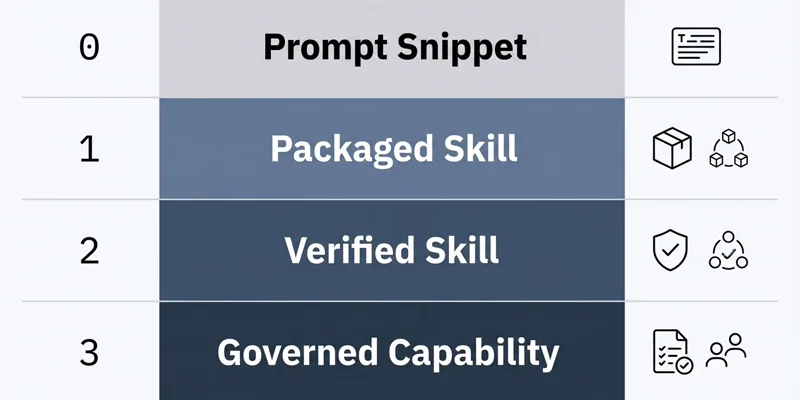
profile-bio is a Level 1 skill. For personal use, that is appropriate. The moment it runs inside a composed workflow — a content creation pipeline, a publishing automation, an onboarding agent — it needs to be Level 2. It is not.
Most published skills sit in the same position: honest Level 1, operating where Level 2 is required. That gap is the same distinction that AI guardrails exist to close.
The Right Framing
A SKILL.md file is packaging. It is not assurance.
Treat a skill like a public API. Test it like a probabilistic system. Secure it like an untrusted plugin. Operate it like a production service.
profile-bio is a skill I am actively improving. The gaps named here are the backlog.
What Comes Next
Part 2 covers what a production-grade skill contract actually looks like — behavioral boundaries, capability manifests, and resource budgets. Part 3 is a Colab notebook that builds a skill with no contract, applies one, and shows you the delta.
Reflection questions
- Pick one skill you own or consume. Can you state its token budget? Its allowed tool list? Its regression test suite?
- At what level in the maturity model does it honestly sit — and at what level should it be, given what it is embedded in?
- What would it take to move it one level up?