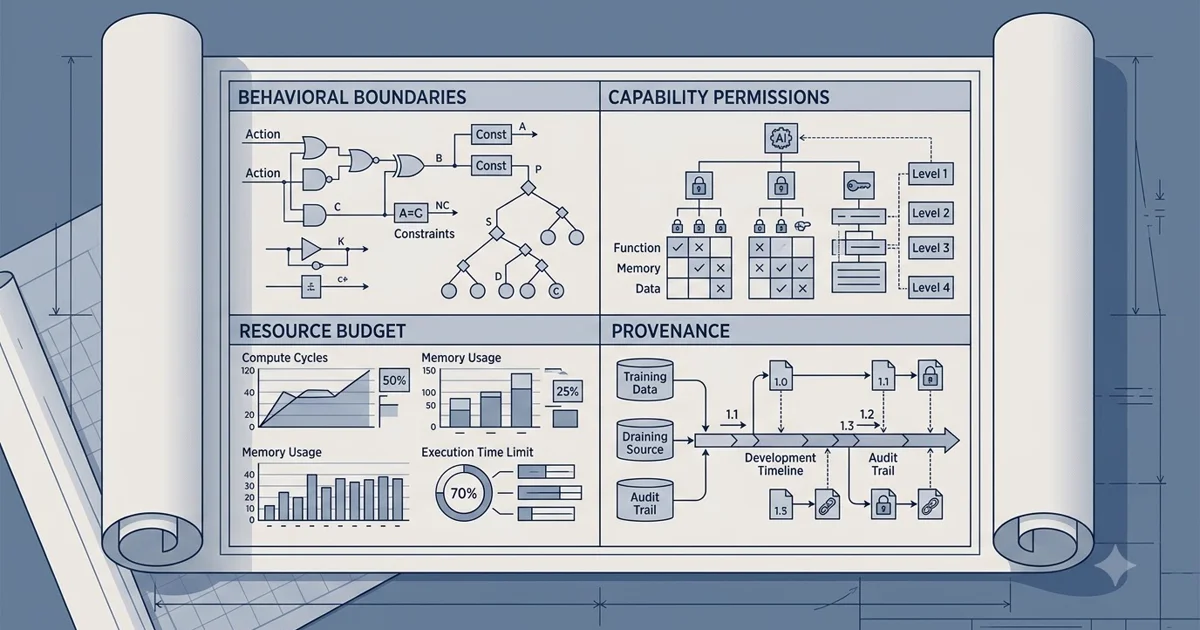
The AI Skill Engineering Contract
Part 2 of 3 in The Resourceful AI Skill series.
Key Takeaways
- The problem: Most AI skills ship with instructions and no contract — no stated boundaries, no resource limits, no enforced permissions.
- Why it matters: A skill without a contract is an open variable. The runtime, the model, and downstream systems fill in the blanks — unpredictably.
- What you’ll learn: The four components every production skill needs: a behavioral contract, a capability contract, a resource budget, and a provenance record.
In Part 1, the argument was simple: most AI skills are being operated at Level 0 or Level 1 of a maturity model that goes to Level 3. The gap is where failures originate.
This post is the engineering side of that argument. What does a production-grade skill actually need to have? Not aspirationally — concretely.
What “No Contract” Actually Means at Runtime
When a skill ships without explicit boundaries, the runtime has to infer them. That inference pulls from whatever is available: the model’s training data, the system prompt, adjacent skill instructions, conversation context, and whatever tools happen to be loaded.
This is not a theoretical concern. It is the reason:
- A skill designed for document summarization starts making API calls when it finds a URL in the input
- A skill intended for read-only analysis writes to a database because nothing in its instructions said it couldn’t
- A skill tested on one model version behaves differently after a quiet platform upgrade — different refusal thresholds, different output format, different tool selection behavior
The fix is not better wording in the instructions. Wording is guidance. A contract is enforcement. The distinction matters.
The Four Components
1. Behavioral Contract
This defines what the skill does, what it explicitly does not do, and what constitutes a correct output.
At minimum:
name: summarize-support-case
version: 2.1.0

intent:
  purpose: "Summarize a customer support case into a structured brief"
  non_goals:
    - "Do not respond to the customer directly"
    - "Do not access case history beyond the provided input"
    - "Do not make recommendations that require account changes"

input:
  schema: support-case-v1.json
  max_size_kb: 200
  untrusted_fields:
    - customer_message
    - attachments

output:
  schema: case-summary-v2.json
  required_fields:
    - issue
    - evidence
    - recommended_next_step
    - confidence
  refusal_conditions:
    - "Input contains no identifiable issue"
    - "Input is under 50 tokens"
The non_goals and refusal_conditions fields are the ones most skills omit. Without them, the model improvises — and improvisation in a production workflow is a defect waiting to surface.
2. Capability Contract
This is the permission manifest. It declares what the skill is allowed to touch — and by implication, what it is not.
capabilities:
  tools:
    allowed:
      - read_support_case
      - classify_issue_type
    denied:
      - send_email
      - update_account
      - execute_code
  data:
    classification: internal
    tenant_scope: requesting_user_only
  network:
    allowed: none
  filesystem:
    allowed: none
  side_effects:
    permitted: []
    requires_approval: []
Two things matter here that most teams miss.
First: the runtime must enforce this manifest, not the skill text. Writing “do not send emails” in the instructions tells the model what to aim for. A capability contract tells the runtime what to allow. These are different enforcement mechanisms and only one of them is reliable.
Second: denied tools should be explicit. An allow list alone is insufficient — if a new tool is added to the runtime after the skill is deployed, an allow-only manifest will silently permit it. Explicit denials close that gap.
3. Resource Budget
Software engineers think in time and space complexity. Agentic skills need a broader cost model.
budget:
  latency:
    p95_seconds: 8
    p99_seconds: 15
  tokens:
    avg_input: 2500
    avg_output: 900
    max_input: 5000
  tool_calls:
    max_per_invocation: 4
    max_retries: 1
  cost:
    max_per_transaction_usd: 0.02
  context:
    max_skill_files_loaded: 3
    max_context_occupancy_pct: 15
These numbers are not guesses. They come from measuring the skill during development against representative inputs, then setting limits at a reasonable headroom above baseline. The Colab notebook in Part 3 shows exactly how to do that measurement.
Without a budget, there is no definition of “this skill is behaving unexpectedly.” A 10x token spike looks like normal variance. With a budget, it is a breach — detectable, alertable, debuggable.
4. Provenance Record
This is the metadata that makes a skill auditable and the registry smarter.
provenance:
  skill_id: "summarize-support-case-v2"
  owner: "support-platform-team"
  source_repo: "github.com/org/skills/summarize-support-case"
  license: "MIT"
  created_with: "claude-sonnet-4-6"
  content_hash: "sha256:abc123..."
  fork_of: null
  end_of_support: "2027-06-01"
  tested_models:
    - "claude-sonnet-4-6"
    - "claude-haiku-4-5"
The fork_of field deserves attention. One of the biggest problems in skill registries is clone inflation — the same skill published under ten names, none of them linked. If every skill declared its lineage, a registry could surface “this skill is 94% similar to X, consider contributing upstream” before accepting publication. That one field could substantially reduce duplication.
The Key Rule
Never rely on the model to enforce the security policy that constrains the model.
This is worth saying plainly because the instinct is to solve constraint problems by adding more instructions. Better wording, clearer prohibitions, more examples. That instinct is wrong for security-critical constraints.
A prompt guides. A contract enforces. The runtime, not the instructions file, must be the policy enforcement point for permissions, tool access, and side effects — the same principle behind why AI guardrails need to be enforced, not just defined.
What This Looks Like End-to-End
A fully contracted skill ships as:
my-skill/
  SKILL.md              ← human-readable description and usage
  contract.yaml         ← the four components above
  instructions.md       ← model instructions (behavioral guidance)
  schemas/
    input-v1.json
    output-v1.json
  tests/
    happy-path/
    negative/
    adversarial/
  evaluations/
    functional.yaml
    routing.yaml
    security.yaml
  CHANGELOG.md
The contract.yaml is the artifact that makes the rest auditable. It is the thing a registry validates, a runtime enforces, and a security review reads first.
What Comes Next
Part 3 closes the loop with a Colab notebook: a skill built with no contract, measured against the dimensions above, then rebuilt with a contract, measured again. The delta tells you what “resourceful” is actually worth in practice.
Reflection questions
- For a skill you own: can you write its
non_goalsandrefusal_conditionsright now, without looking at the code? - If a new tool is added to your agent runtime tomorrow, which of your deployed skills would silently gain access to it?
- What is the P95 latency and average token cost of your most-used skill? If you don’t know, that’s the first measurement to take.