Key Takeaways
- The problem: Governance slows AI deployments not because reviewers are obstructive, but because the AI stack arrives without the structured information reviewers need to say yes quickly.
- Why it matters: Speed versus governance isn’t a tension to manage — it’s an architecture problem to solve. Making AI systems legible earns the trust that unlocks autonomy.
- What you’ll learn: The AI Bill of Materials — a governance primitive that flips review from discovery to verification — plus a multi-model strategy that prevents vendor lock-in masquerading as AI strategy.
Post 4 made the case that deferring AI readiness has a real cost — compounding, measurable, and eventually unrecoverable. So let’s say you’re ready to move. You have leadership buy-in, a use case, and a team.
Then governance gets involved, and the project slows to a crawl.
This is the moment most teams treat as a tradeoff: move fast and route around governance, or move slow and stay compliant. The organizations winning at enterprise AI have rejected that frame entirely. Speed versus governance isn’t a tension to manage. It’s an architecture problem to solve.
The governance team isn’t wrong — you just arrived without the information they needed
Here’s the thing nobody says out loud: when a governance reviewer slows down an AI deployment, they’re usually making the correct call given the information they have.
An AI deployment with no documented model lineage, no clear data flow, no agent topology, no stated failure modes — that’s a black box. A rational reviewer treats every black box as maximum risk, because they have no other basis for assessment. They ask more questions. They escalate. The timeline slips.
The problem isn’t the reviewer. The problem is that the deployment arrived without the information the reviewer needed to say yes quickly.
This is fixable. And fixing it doesn’t require slowing down the engineering team — it requires making the AI stack visible in a way governance can actually use.
Introduce the AI Bill of Materials
A software Bill of Materials (SBOM) is an established practice in supply chain security — a structured inventory of every component in a software artifact. The same concept applies to AI systems, and most enterprises don’t have one.
An AI BOM is a governance primitive. It’s not a lengthy document. It’s a structured snapshot of what’s running in production:
- Model registry entry — which model, which version, which provider, last evaluation date
- Data flows — what data the model receives, what systems it reads from, what it writes to
- Agent topology — if agents are involved, what they’re orchestrating, what tools they can call
- Integration surface — every downstream system that acts on model output
- Known failure modes and mitigations — what can go wrong, what contains it
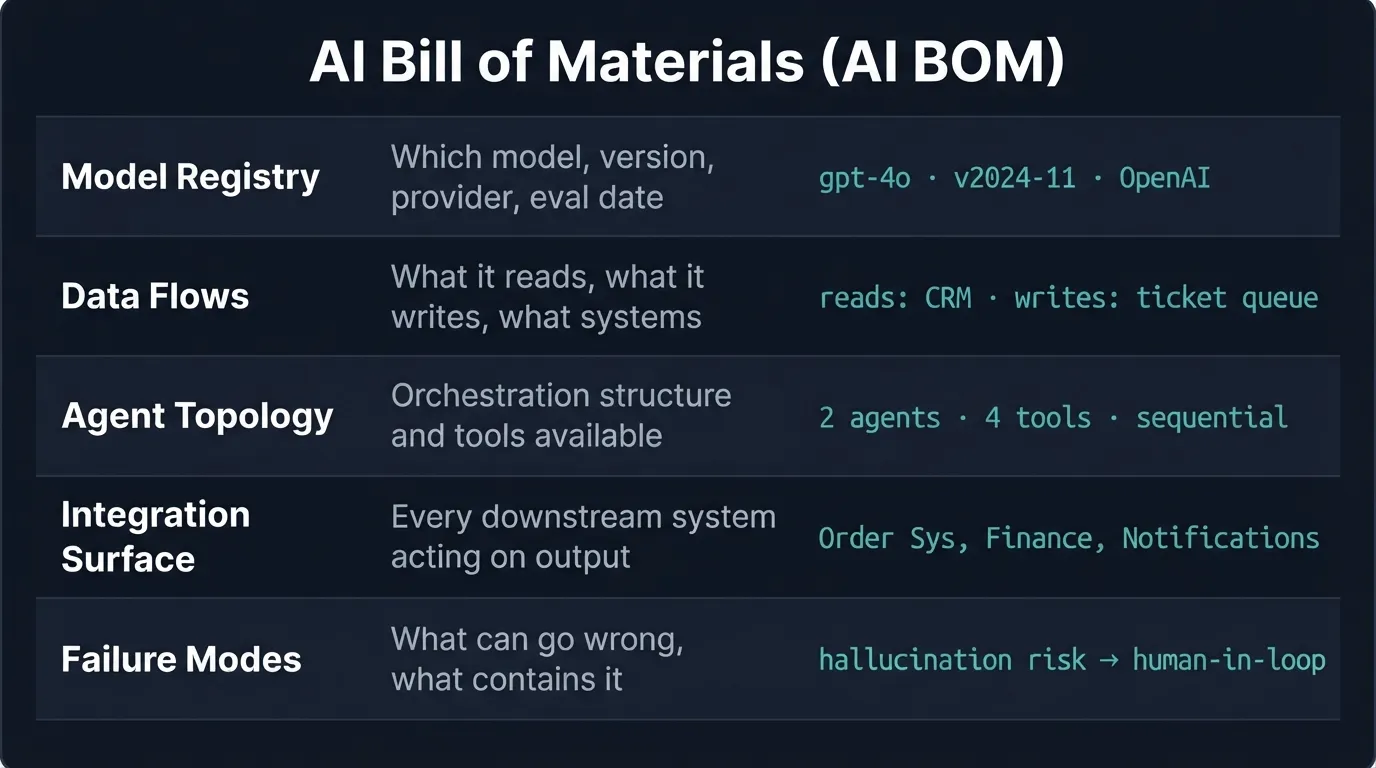
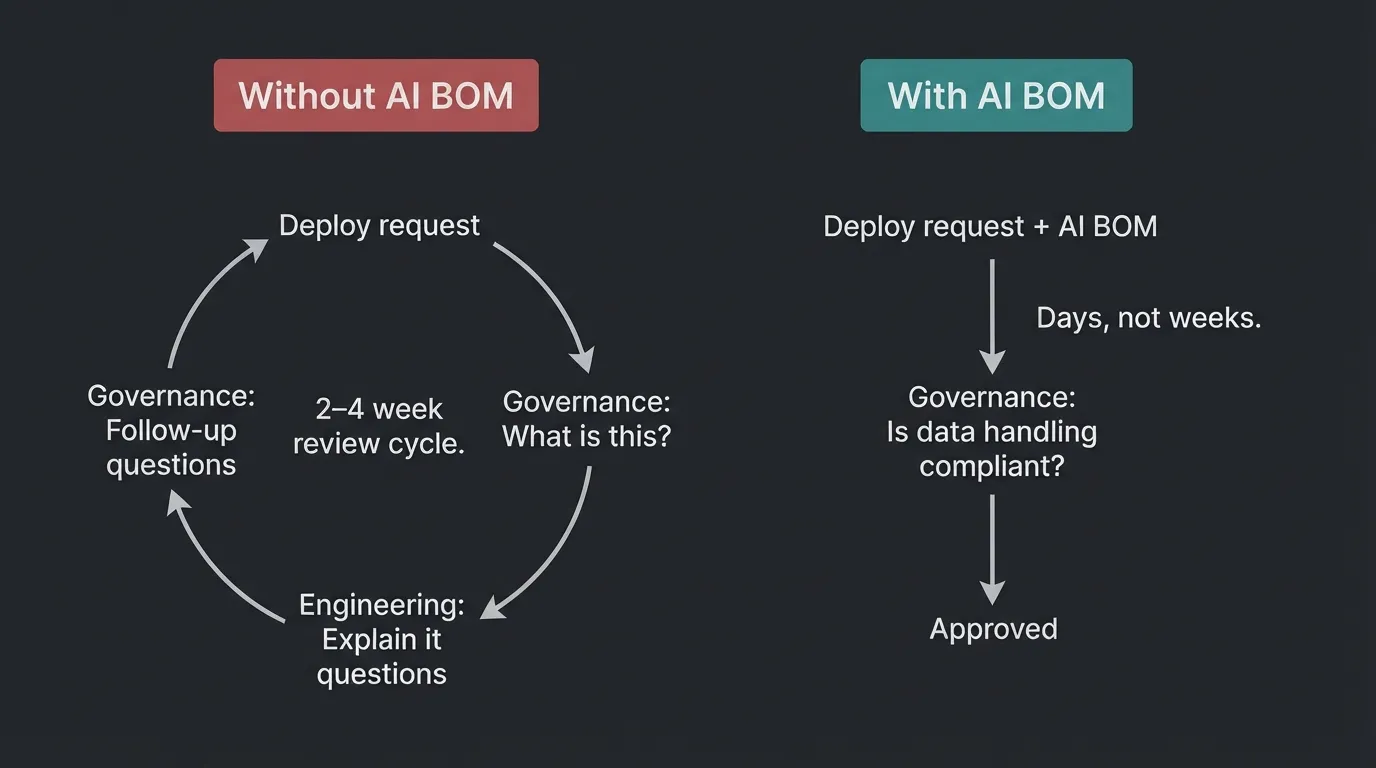
When a governance team can read this document and immediately understand the stack, the approval conversation changes. Instead of “we need to understand what this system does before we can approve it,” the question becomes “is the data handling compliant?” — a much faster question to answer.
The AI BOM flips the dynamic: it transfers the burden of explanation from a back-and-forth review process to a structured artifact the team produces upfront. Teams that do this consistently find that governance approvals accelerate — not because the bar dropped, but because reviewers now have context instead of anxiety.
In my experience, the first time a team shows up to a governance review with a properly structured AI BOM, the dynamic shifts noticeably. The reviewer stops asking exploratory questions — “what data does this touch?”, “what happens if it’s wrong?” — because the document already answers them. The review becomes a verification conversation instead of a discovery one. That’s not a faster rubber stamp. It’s a faster yes because the work was done upfront.
Treat the AI BOM as a first-class artifact. Version it. Update it when the stack changes. Store it alongside the deployment config. If an AI system is running in your production environment without one, you don’t actually know what you’re running.
Don’t build your AI strategy on a single model — that’s a single point of failure with extra steps
While governance is the friction problem, model monoculture is the fragility problem. Most enterprises still operate as if AI strategy means picking a flagship LLM and building everything on it.
That’s a single point of failure with extra steps.
A multi-model strategy means selecting different models for different tasks based on fit — not defaulting everything to the most capable (and most expensive) model you can find. The practical pattern:
| Task class | Model tier | Rationale |
|---|---|---|
| Complex analysis, multi-step planning, structured extraction | Frontier (e.g. GPT-4o, Claude Sonnet/Opus) | Capability justifies the cost; errors here are expensive |
| Classification, summarization, routing, triage | Small/fast (e.g. Claude Haiku, GPT-4o-mini) | High volume, lower stakes — cost and latency matter more |
| Code generation | Code-tuned (e.g. Claude, Codex variants) | Domain fine-tuning outperforms general models on code tasks |
| Legal or compliance text | Domain-tuned or general with RAG | Evaluate against your specific regulatory context before deciding |
| Real-time user-facing interaction | Fast + cheap, latency-optimized | Perceived responsiveness matters more than marginal capability gain |
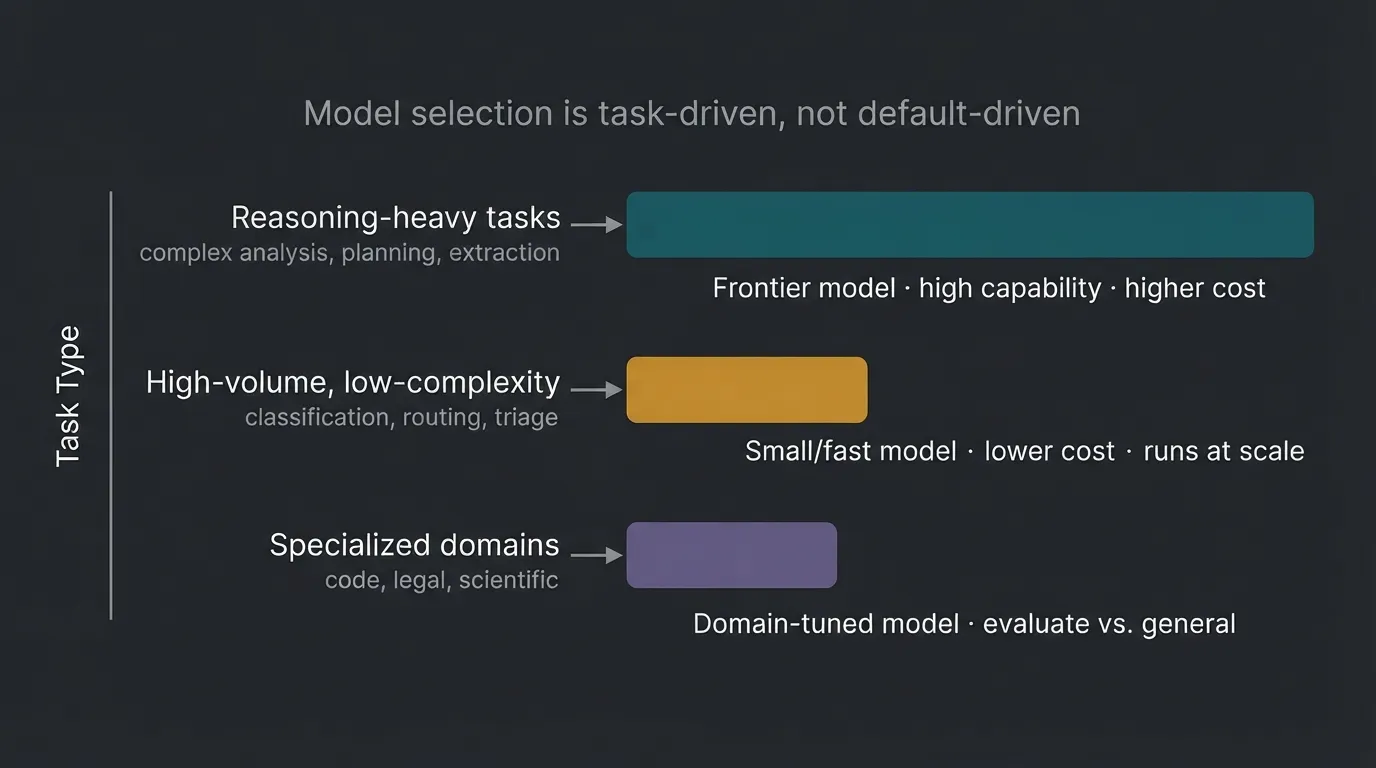
This isn’t just a cost optimization. It’s architectural resilience. When a provider has an outage, raises prices, or deprecates a model version, a multi-model stack has options. A single-model stack has a crisis.
The governance implication: your AI BOM should document which model handles which task class, with the rationale. That documentation is also your contingency plan. When you need to swap a model, the BOM tells you exactly what the change touches.
Governance policy only holds if the runtime architecture can actually enforce it. For the developer-level breakdown on what happens when agents call tools without hard boundaries — and what securing that looks like in code — see Prompt Injection, MCP, and the Trust Boundary Problem.
What a defensible AI strategy actually looks like
A multi-model strategy without governance visibility is a liability — you have a complex stack that nobody can fully explain or audit. Governance without a multi-model strategy is brittle — you’ve made compliance easy but created a single-vendor dependency that governance itself should be worried about.
Together, they form the foundation of a strategy that can move:
- Every AI deployment ships with an AI BOM. No exceptions.
- Model selection is task-driven, not default-driven. Document the decision.
- Governance reviews the BOM, not the model — the model is already decided. The review is about exposure, data handling, and failure containment.
- Update the BOM when the stack changes. Treat a model swap the same as a schema migration — it has downstream effects that need to be tracked.
The goal isn’t to make governance faster by making it weaker. It’s to make governance faster by making your AI systems legible. Legibility earns trust. Trust earns autonomy. Autonomy is what speed actually looks like at enterprise scale.
A non-blocking governance model is one of the key operational prerequisites to becoming genuinely AI-native — not just running AI experiments. For the complete picture of what crossing that line actually looks like, see What AI-Native Actually Looks Like — A Working Definition.
Strategy tells you where to go. The platform has to carry you there — and most DevOps and platform engineering teams are about to discover that agentic workloads break assumptions they didn’t know they were making. → Post 6: Why Your CI/CD Pipeline Isn’t Ready for AI Agents