Key Takeaways
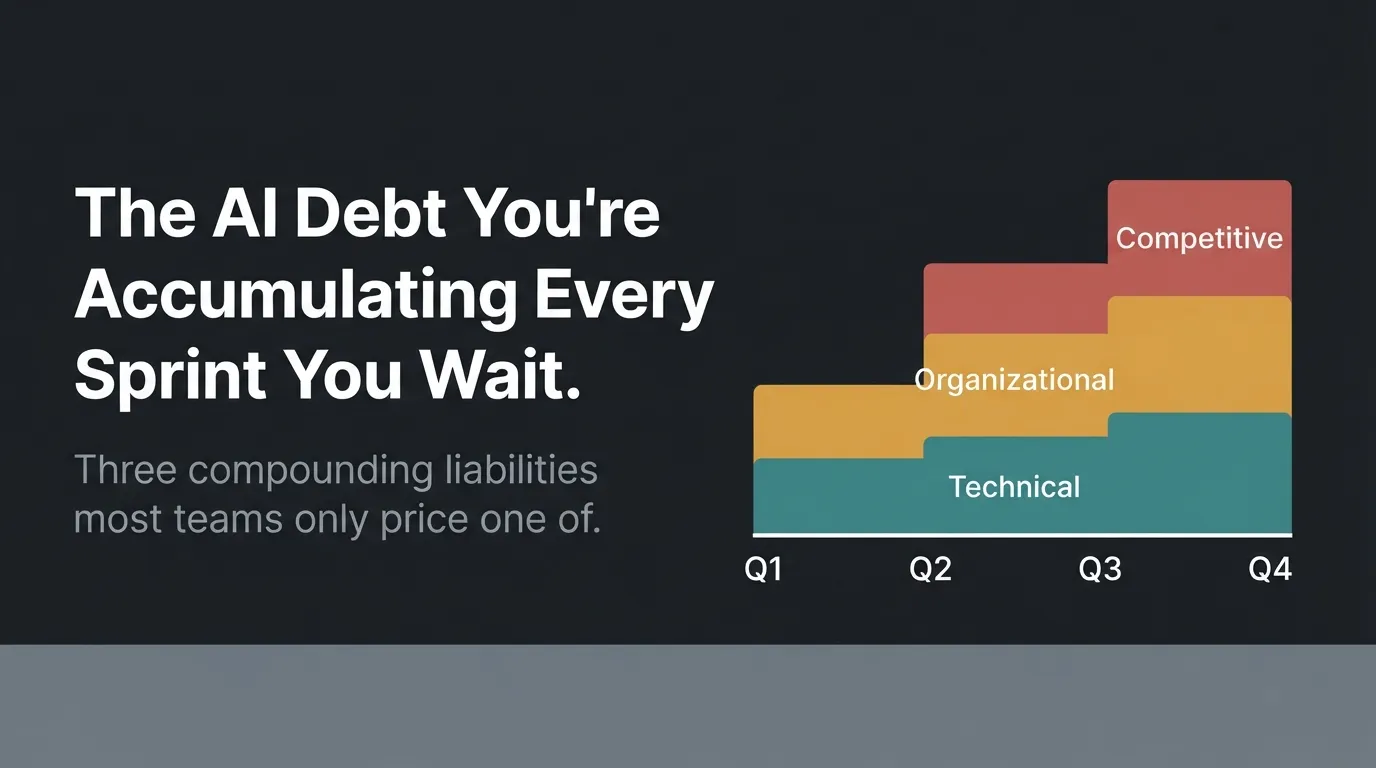
- The problem: Deferring AI readiness is framed as “not spending now” — but it silently accumulates three compounding liabilities: technical, organizational, and competitive.
- Why it matters: The costs don’t land as line items. They arrive in future sprints as architecture that needs unwinding, engineers who need retraining, and a product catch-up effort at exactly the moment the team is least ready.
- What you’ll learn: How to frame all three debt types concretely — and the three questions that make the cost of waiting impossible to argue away in a budget conversation.
Post 3 gave you a readiness assessment — five questions that reveal how exposed your organization actually is. Maybe the answers were uncomfortable. Maybe leadership looked at them and said, “We’ll revisit this next quarter.”
That decision to wait isn’t neutral. It’s a choice to accumulate debt. Three kinds simultaneously.
Debt isn’t just technical
When most engineers hear “debt,” they think code. And yes, one kind of AI debt is technical. But the other two are quieter, more organizational — and they compound faster than most managers realize when they’re making the case to hold off another quarter.
Technical
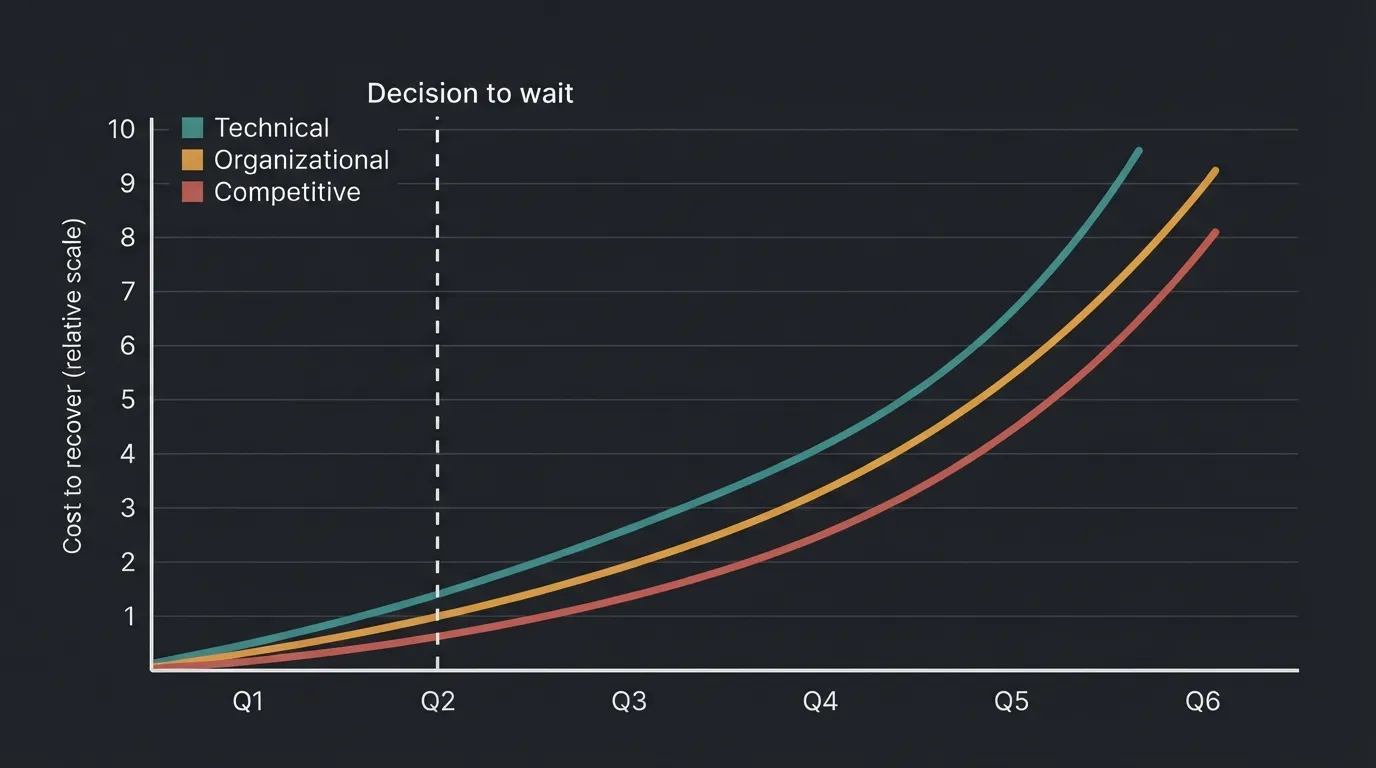
Every sprint where architectural decisions are made without AI in mind makes the future refactor more expensive.
Concrete examples: you’re splitting a monolith and you build the service boundaries around today’s data ownership model — which works fine for current integrations but makes it nearly impossible to create the unified context layer AI needs later. You build a new logging pipeline with structured data, but the schema is proprietary and not designed for retrieval. You add a feature that calls a third-party API and hardcodes the response parsing — now that data is locked away from any downstream AI reasoning.
None of these feel like AI decisions at the time. They are.
Six months from now, adding AI-native capabilities to these systems will require touching all of it. Not because the AI is hard — because the decisions made without it in mind are now load-bearing walls.
The earlier you start building with AI context in mind, the cheaper the architecture stays.
Organizational
Skills gaps compound.
An engineer who starts building with AI-native patterns today — working with embeddings, prompts, retrieval pipelines, tool use — is going to be significantly more capable in 6 months than the engineer who waited. Not because one is smarter. Because applied practice creates depth that reading about it cannot.
The gap between “teams actively building with AI” and “teams planning to build with AI” grows every sprint. And when your organization eventually needs to move fast — because a competitor shipped something your users want — you’ll be hiring into a market that’s already been drained by teams that started earlier.
This one rarely shows up in budget conversations. It should.
One of the most dangerous hidden costs here is developer comprehension drift — the gap between code that runs and code the team can actually reason about. That gap widens every sprint AI-generated code ships without genuine understanding behind it. The Cognitive Debt Crisis in AI-Augmented Codebases breaks down exactly how that mechanism works.
Competitive
This is the one that tends to land hardest when you name it clearly.
Competitors shipping AI-native features aren’t just ahead of you in the present. They’re running experiments you haven’t started yet. They’re collecting user feedback on workflows you’re still designing. Their models are being fine-tuned on real interaction data. Their teams are getting smarter about what works.
The gap isn’t static. It’s widening, sprint by sprint.
A competitor who shipped an AI-native feature six months ago has feedback loops you haven’t started yet. You’re not six months behind. You’re behind on the learning that six months of real usage produces — and that learning is what shapes the next iteration.
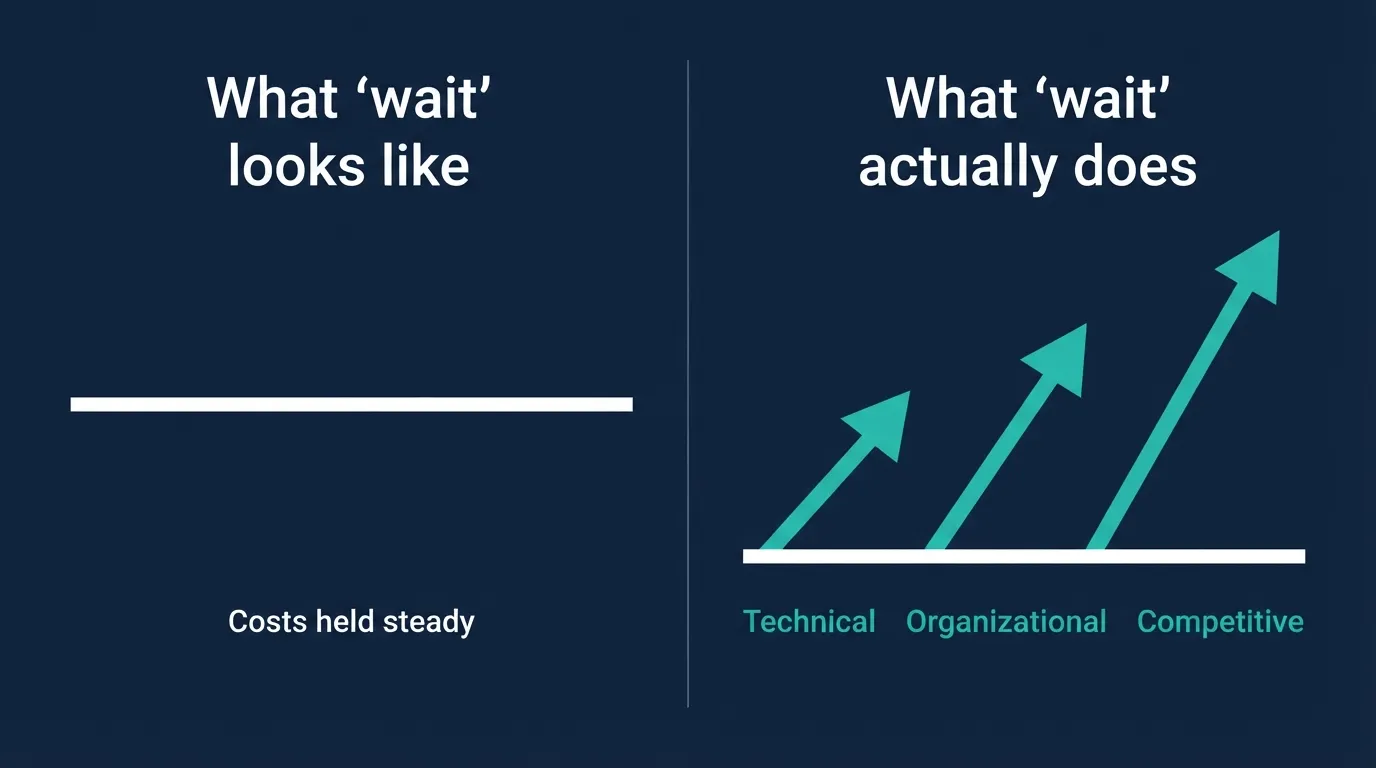
You’re not holding steady while you wait. You’re falling further behind a moving target — and the target is accelerating.
The frame most deferral arguments use
Here’s why “wait” gets approved: the argument is almost always framed as “not spending now.”
What’s not accounted for: technical decisions made this quarter that will need to be unwound later. Engineers who will need expensive retraining or replacement. A product catch-up effort that will require moving fast at precisely the moment your team is least ready to.
None of those show up as line items. But they’re real costs — they just land in future sprints, future quarters, under different budget headings.
What a 6-month delay actually costs
Not in dollars — those estimates are always argued away. Instead, frame it in concrete capability gaps:
- Architecture: Which systems built this quarter will require refactoring before AI can reliably use them?
- Skills: Which engineers are building AI-native muscle right now, and which ones will still be on tutorials 6 months from now?
- Product: Which features are competitors already shipping that are collecting feedback you’re not?
Walk through those three questions with your team before the next budget conversation. The answers won’t give you a dollar figure. They’ll give you something harder to dismiss: a concrete picture of what you’re actually deciding when you decide to wait.
That’s the conversation worth having.
When you’re ready to move from waiting to building — especially if you’re managing a growing fleet of AI workflows — When You Have 10 Agents in Production: Spec-Driven Development at Scale shows how to keep engineering velocity compounding rather than accumulating into a new form of debt.
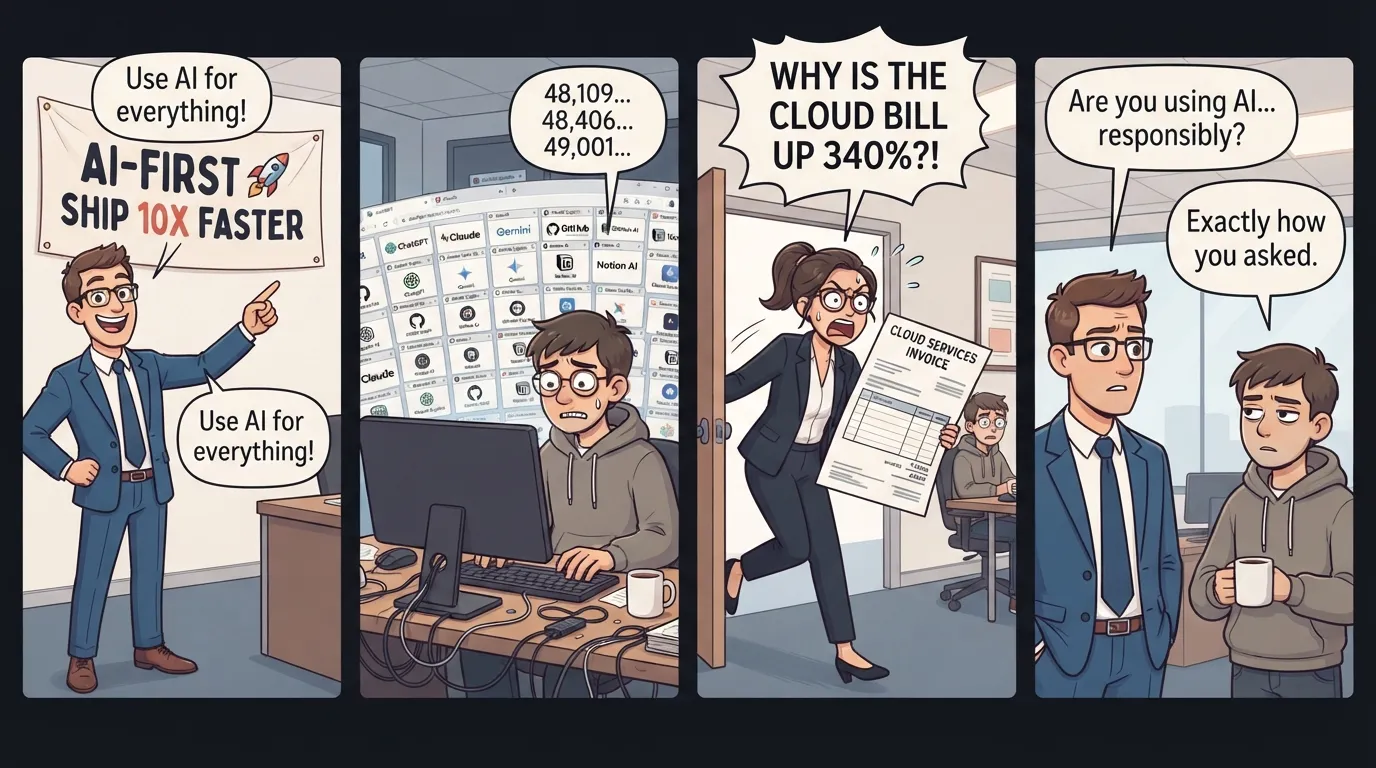
🏢 Company: “We’re an AI-first organisation now. Use AI for everything. Ship 10x faster.”
👨💻 Employee: (opens 14 browser tabs, pastes entire codebase into ChatGPT, asks Claude to fix what ChatGPT broke, asks Gemini for a second opinion)
📈 Token meter: 📊📊📊📊📊📊📊 [and climbing]
💸 Finance team: “Erm… why is our cloud bill up 340% this month?”
🏢 Company: “…are you using AI responsibly?”
👨💻 Employee: “I am using it exactly how you asked.”
The real AI debt isn’t on the credit card. It’s in the strategy gap between “use AI more” and “here’s how.”
Next: Understanding the cost of waiting is half the battle. The other half is building a strategy that governance doesn’t strangle before it ships anything. → Post 5: Building an AI Strategy That Governance Doesn’t Kill