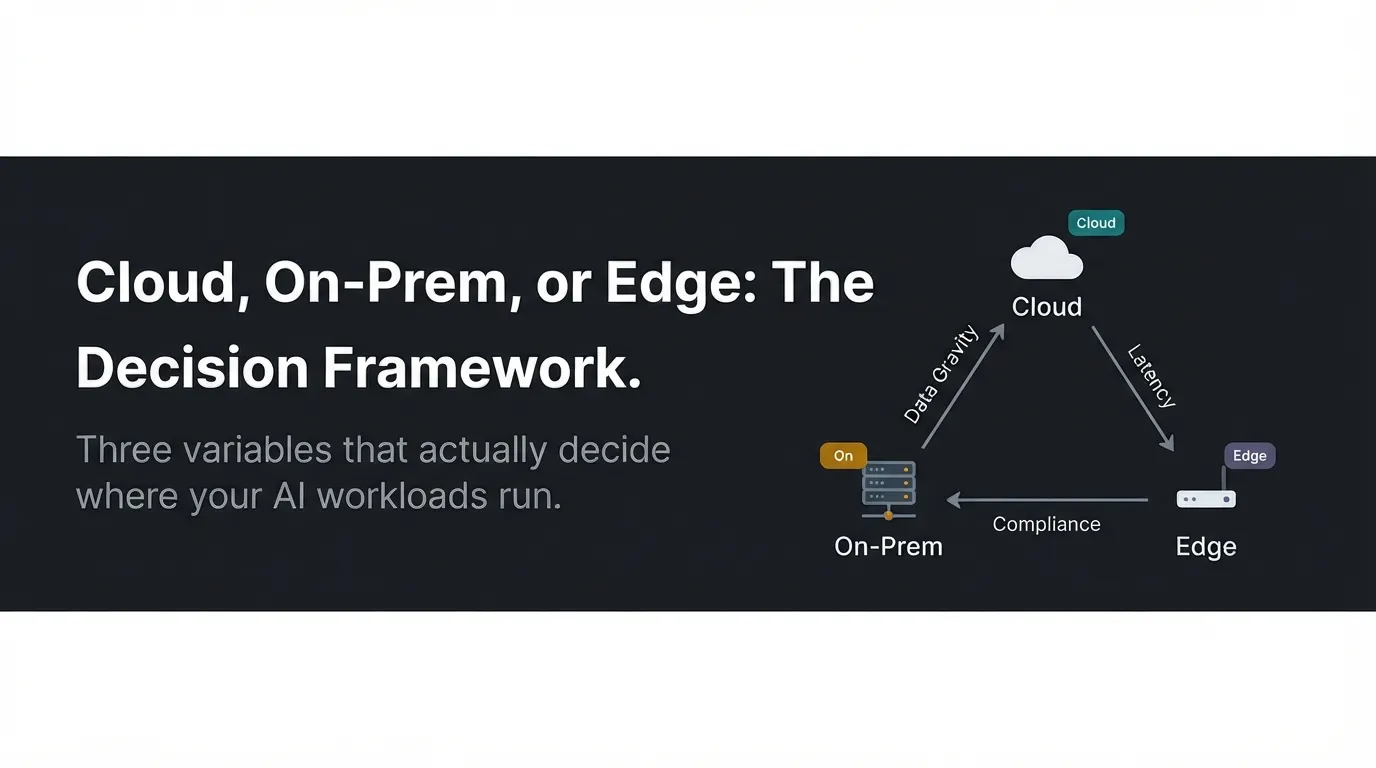
Key Takeaways
- The problem: Cost drives most AI deployment debates — but in regulated enterprise environments, cost is the wrong frame. Three other variables make the actual decision.
- Why it matters: Data gravity, inference latency requirements, and compliance surface area are often non-negotiable constraints. Picking a deployment model without working through them first creates architecture you’ll be unwinding later.
- What you’ll learn: The three-variable decision framework for cloud, on-prem, and edge AI workloads — with three concrete scenarios showing how the framework plays out in practice.
Post 8 got your observability layer in place — you can see what your agents are doing in production. Now comes the question every team hits eventually: where do you actually run the thing?
The default answer is “cloud.” It’s elastic, it’s fast to provision, and your ops team probably already lives there. In many cases, cloud is the right answer. But in regulated enterprise environments, the question isn’t “cloud or not?” — it’s “which constraints are non-negotiable, and which deployment model survives all of them?”
Cost is usually what drives the debate. Cost is usually the wrong frame — unless compliance and latency don’t constrain the decision, in which case cost becomes a legitimate tiebreaker. But in regulated enterprise environments, those constraints are almost always present, and they’re binary: they don’t bend.
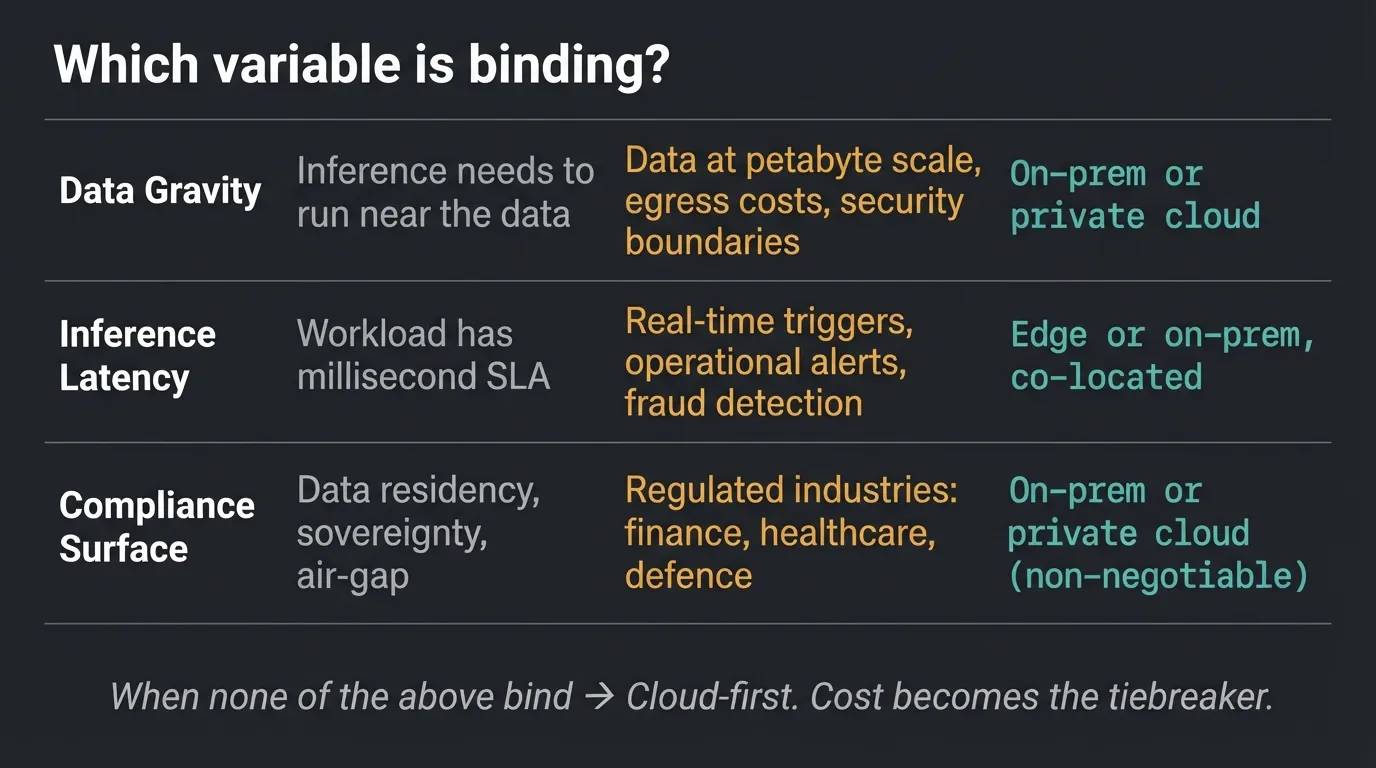
The three constraints that actually make the decision — cost comes last
1. Data gravity
Your AI workload needs to reason over data. That data lives somewhere. Moving it — especially at petabyte scale — is expensive, slow, and creates its own compliance exposure.
Data gravity is simple: inference should run close to where the data already lives, not where it’s convenient to deploy compute. If your operational data warehouse, customer records, or real-time event streams live on-prem or in a private cloud, pulling that data into a public cloud endpoint for inference adds latency, egress costs, and a data transfer boundary that your security team will flag.
Ask this first: where does the data actually live today, and how often does inference need to touch it?
Data gravity is also why most enterprise AI experiments die at the proof-of-concept stage. When operational data was never designed to be queried across system boundaries, the inference layer has nothing reliable to reason over. Why Enterprise AI Projects Keep Failing (And It’s Not the Models) goes deeper on that pattern — and why it’s almost never a model problem.
2. Inference latency requirements
Not all AI workloads have the same latency budget.
A document summarization job that runs overnight? A 3-second response is fine. A real-time customer interaction, a fraud detection trigger, or an operational alert that needs to fire within milliseconds? That 3-second window is a hard failure.
Public cloud inference adds network round-trips. Depending on your data center location relative to cloud regions, that can mean 50–200ms of baseline network latency before the model even begins processing — before inference time is added on top. For some workloads that’s nothing. For others it’s a showstopper.
Be honest about the latency floor before picking a deployment model.
3. Compliance surface area
This is the one that often gets underweighted until someone in Legal or InfoSec reviews the architecture.
Data residency requirements, sovereignty mandates, and air-gap requirements are non-negotiable. They don’t bend because the cloud provider has a data center in your region. They don’t bend because you have encryption at rest. In heavily regulated industries — financial services, healthcare, defense, government — the compliance posture is often: the data does not leave a defined boundary, full stop.
If your AI workload touches data with those requirements, the deployment decision has already been made. Compliance surface area isn’t a constraint to optimize around; it’s the outer boundary that the rest of the architecture fits inside.
Workload placement is ultimately a compliance architecture problem. To align your hosting decisions with your enterprise risk posture — and avoid building an AI strategy your governance team will stall — see Building an AI Strategy That Governance Doesn’t Kill.
Most enterprises are already hybrid — here’s how to design it intentionally
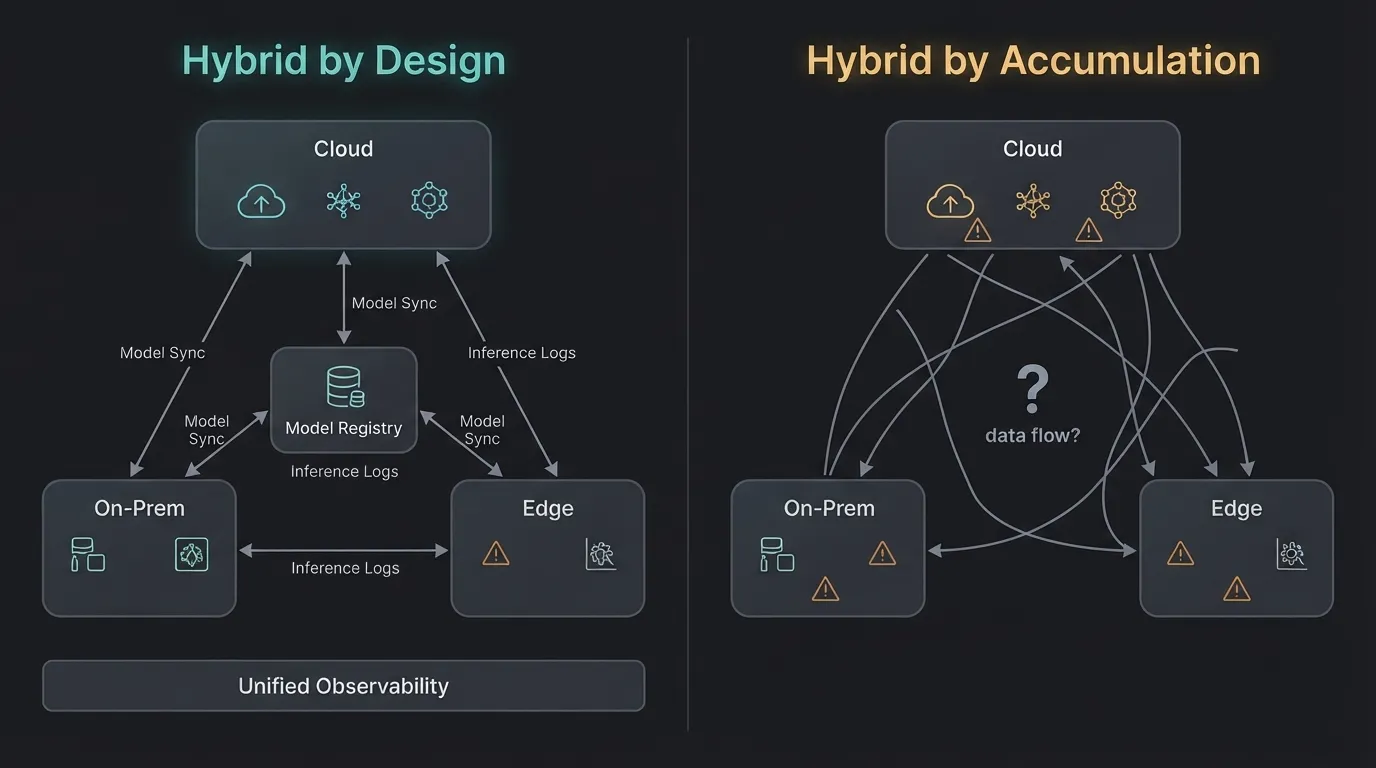
Most enterprises that have been at this for more than 18 months end up with a hybrid deployment. Some workloads on-prem. Some on edge. Some in cloud. And at some point, someone realizes there’s no coherent picture of where AI workloads live, who owns the inference infrastructure, or how data flows between layers.
That’s not a hybrid architecture — it’s deployment sprawl with a nicer name.
If your AI footprint is going to span deployment models (and it will), design the hybrid intentionally from the start. That means: a common model registry accessible from all deployment targets, a consistent observability stack that works across cloud, on-prem, and edge, clear data flow contracts between layers, governance that spans the whole topology, and unified cost attribution across all deployment targets — separate billing systems for cloud tokens, on-prem compute, and edge hardware create blind spots that make it impossible to decide which workloads to migrate or optimize.
Hybrid by design is tractable. Hybrid by accumulation is a year-two cleanup project.
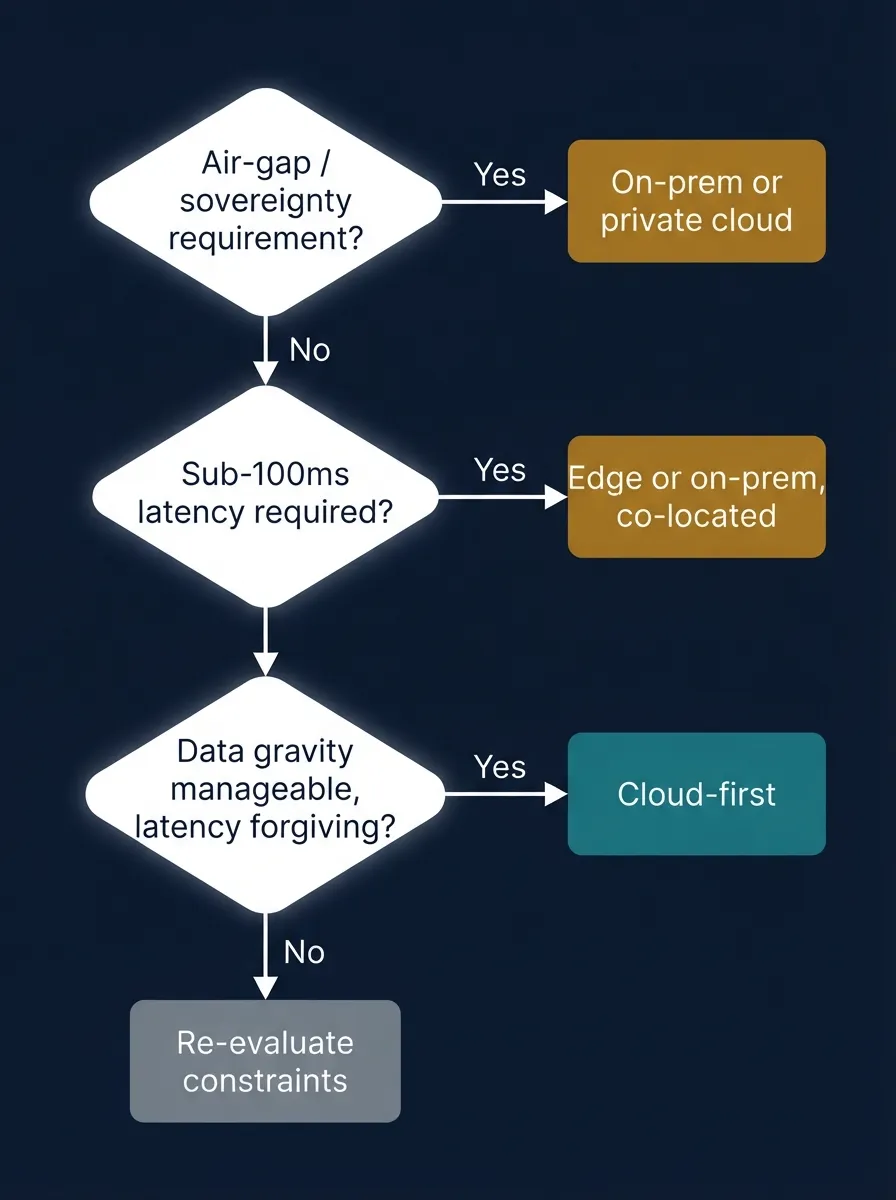
Three scenarios where the framework plays out in practice
Scenario A: Regulated financial data
Primary variable: compliance surface area
Transaction records, customer financial data, and trade history carry data residency and sovereignty requirements in most jurisdictions. A model reasoning over that data to detect anomalies, generate reports, or flag risk patterns cannot do so through a public cloud endpoint in most regulated environments.
Deployment decision: on-prem or private cloud. The compliance boundary is decisive. Data gravity reinforces it — the data already lives there. The latency tolerance for batch analytical workloads is usually forgiving enough that on-prem compute isn’t a bottleneck.
Scenario B: Real-time operational triggers
Primary variable: inference latency
An AI workload that monitors sensor data to trigger maintenance alerts, or processes transaction streams to flag anomalies in real time, has a latency budget measured in milliseconds. Any network hop to a central cloud adds variance that makes the SLA unreliable.
Deployment decision: edge or on-prem, co-located with the data source. The latency requirement is decisive. Running a smaller, quantized model on edge hardware near the data source is usually the right tradeoff — even if that model is less capable than what you’d run in a full cloud deployment.
Scenario C: Knowledge work augmentation
Primary variable: data gravity (manageable) and latency (forgiving)
An AI assistant that helps analysts draft reports, summarize documents, or query knowledge bases is working with data that can be retrieved via API, and the human in the loop tolerates a 1–3 second response. There’s no air-gap requirement, and the data volumes are query-sized, not warehouse-sized.
Deployment decision: cloud-first. There’s no architectural reason not to use managed cloud inference here. The elastic scaling, lower operational overhead, and access to the latest model versions are genuine advantages. Don’t make this harder than it needs to be.
The deployment location question isn’t interesting when compliance or latency makes the decision for you. It gets interesting in the middle — when multiple models are viable and you have to be honest about which constraints are real versus assumed. Work from the three variables. The answer usually gets clearer than you’d expect.
Next: Distributed deployments expand your attack surface. When agents start calling tools via MCP, the trust boundary problem becomes load-bearing — and most teams aren’t thinking about it until something goes wrong. → Post 10: Securing the Agentic Surface: Trust, Boundaries, and MCP