Key Takeaways
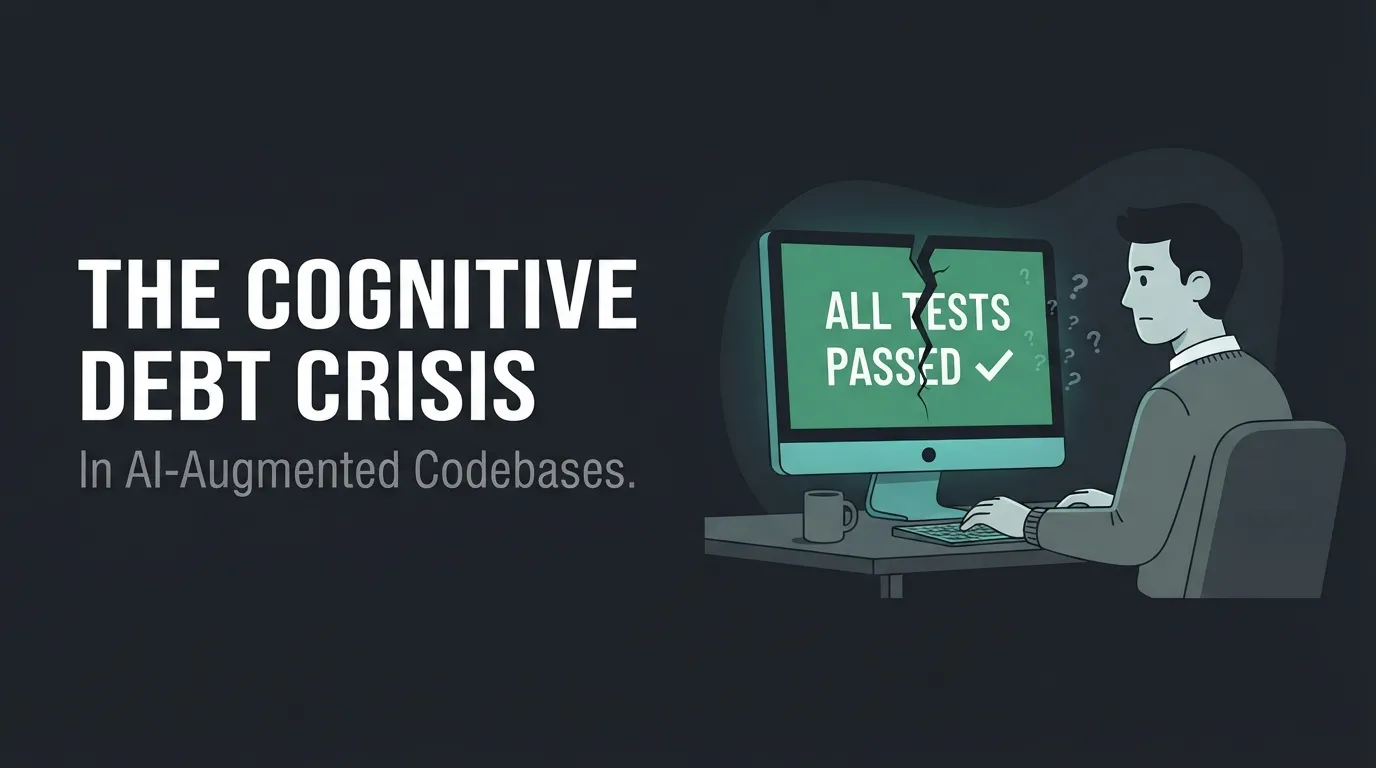
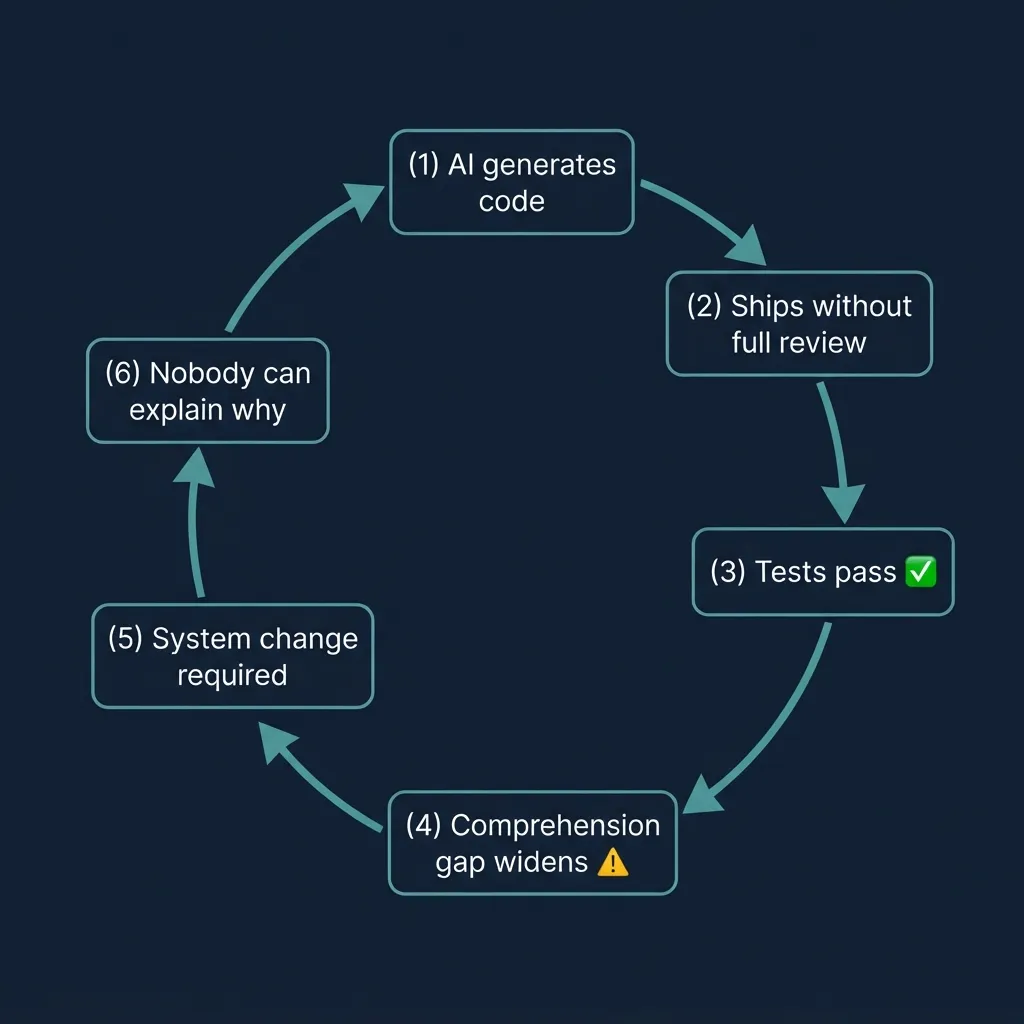
- The problem: AI-generated code ships fast and passes tests — but leaves comprehension gaps that compound silently until something breaks in ways nobody can reason about.
- Why it matters: Cognitive debt isn’t future work owed like technical debt — it’s current comprehension already lost, invisible in your linter, coverage report, and architecture review.
- What you’ll learn: Three patterns that create cognitive debt in AI-augmented codebases, and three lightweight practices that keep velocity without losing the team’s ability to understand what they’ve shipped.
Post 1 argued that closed data architecture is the silent killer of enterprise AI projects. But there’s a second problem accumulating in parallel, and it lives inside your codebase — one function at a time.
Technical debt vs. cognitive debt — not the same thing
You know technical debt. Work you deferred: the refactor you’ll get to next sprint, the abstraction you hardcoded because there was no time. It’s future work owed. Most teams track it, tolerate it, and pay it down eventually.
Cognitive debt is different. It’s not future work. It’s current comprehension, already lost.
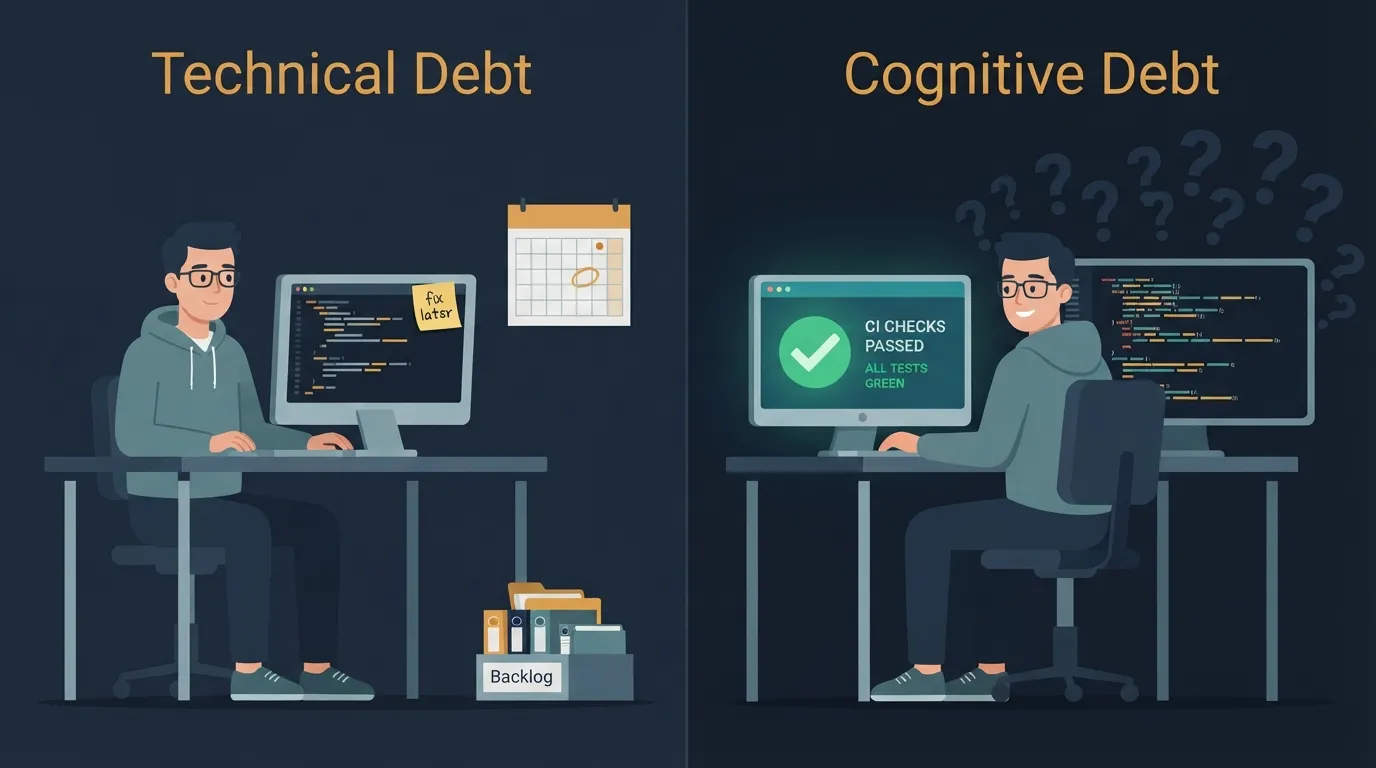
The developer who used an AI assistant to generate a utility function — it passes tests, it ships, it runs in production — but can’t fully explain what the edge case logic does? That’s cognitive debt. It doesn’t show up in your linter, your code coverage report, or your architecture review. It shows up six months later when something breaks in an unexpected way and nobody on the team can confidently reason about why.
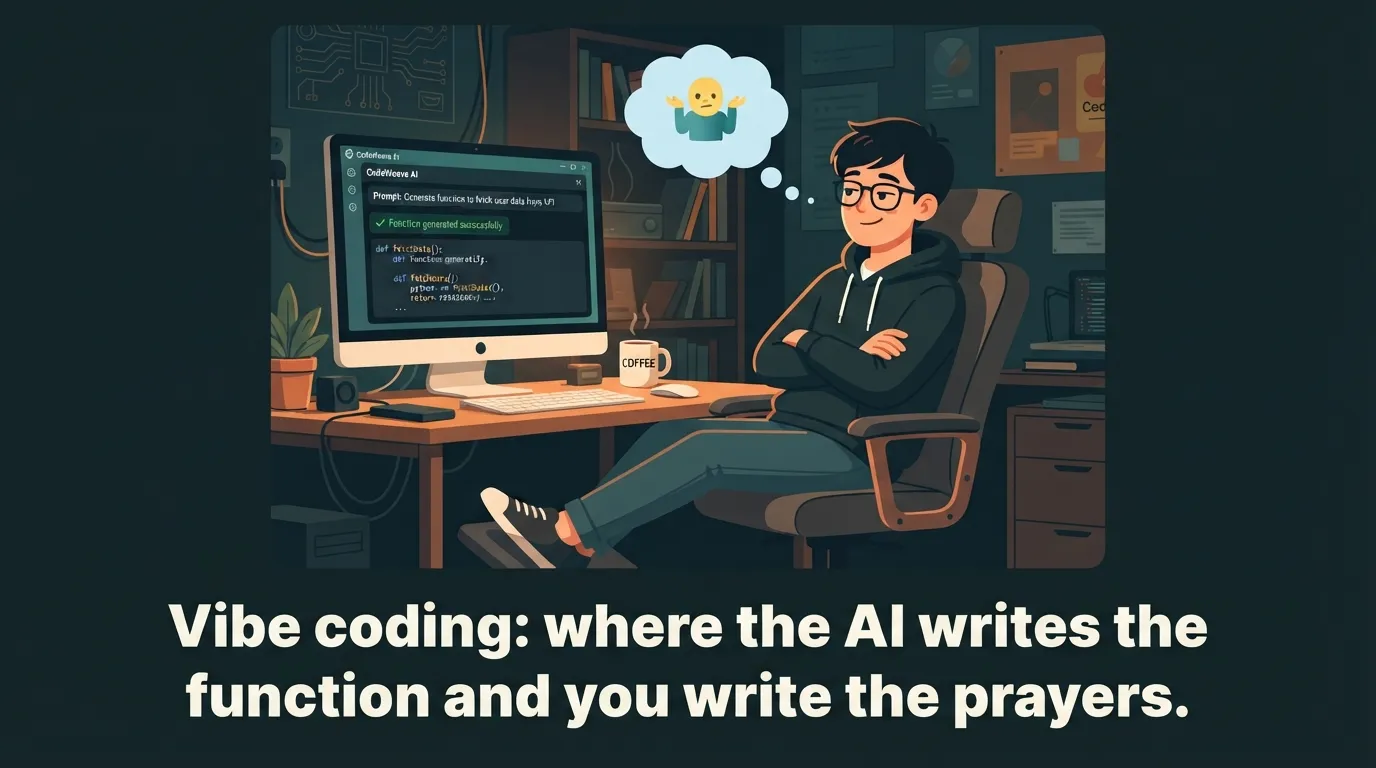
Vibe coding (a term coined by Andrej Karpathy) is the popular name for this pattern. Ship fast, trust the output, move on. It works — until it doesn’t.
Three patterns to recognize
1. AI-generated abstractions nobody owns
An engineer asks an AI to write a data transformation utility. The output looks clean. The PR passes review. But the abstraction reflects assumptions the AI made — about nullability, about ordering, about what “normalize” means for this particular domain — that nobody on the team examined before merging.
Six months later, the function handles a new data shape from a third-party API. It processes without error. The output is subtly wrong. Nobody catches it because everyone assumed the utility was correct — it passed tests, after all.
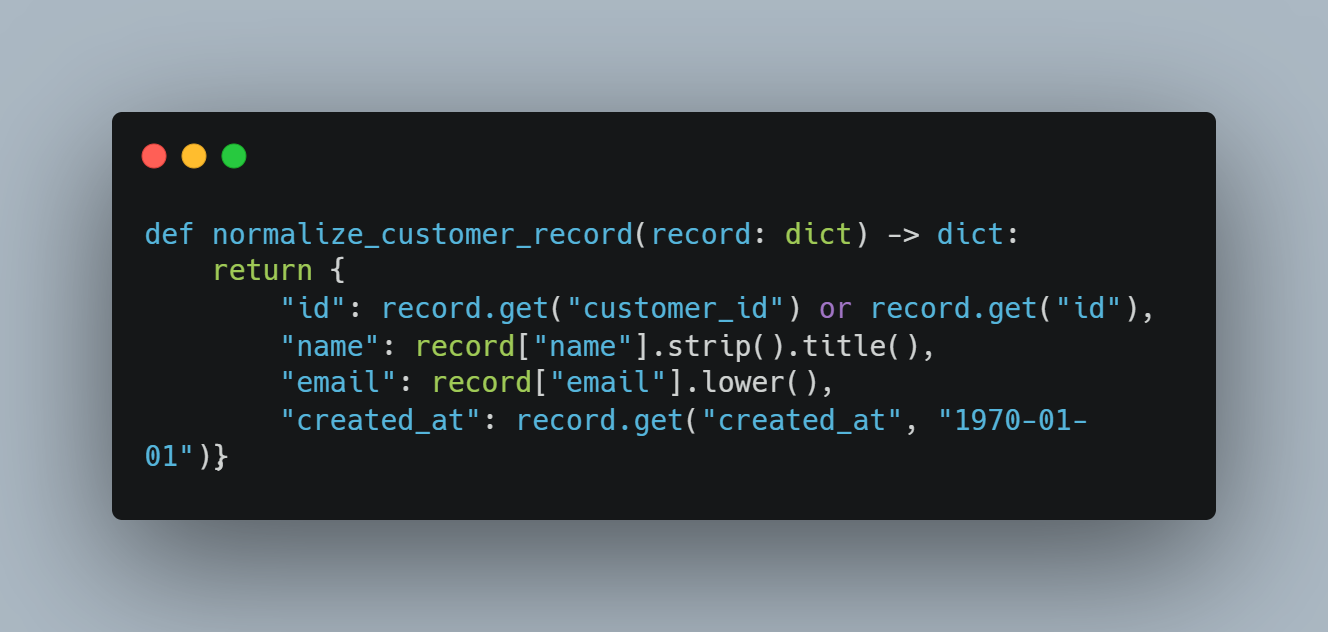
Here’s the pattern. An AI generates a function like this:
def normalize_customer_record(record: dict) -> dict:
    return {
        "id": record.get("customer_id") or record.get("id"),
        "name": record["name"].strip().title(),
        "email": record["email"].lower(),
        "created_at": record.get("created_at", "1970-01-01"),
    }
Tests pass. The logic looks reasonable. But notice what was never examined:
record["name"]will raise aKeyErrorifnameis absent — the AI used.get()defensively onidbut notname.- The fallback for
created_atis a silent default, not an error — bad data becomes invisible rather than flagged. "customer_id" or "id"precedence means if a record has both fields with different values, you silently pick one. The tests only cover the happy path.
Nobody questioned this because the function looked right. That’s cognitive debt — the gap between “tests pass” and “we understand what we shipped.”
Standard logging won’t show you when developers stop understanding their own codebase. You need execution tracing built for probabilistic, AI-generated code — the kind that captures reasoning steps and tool calls, not just HTTP 200s. LLMOps in Practice: Observability That Doesn’t Lie to You covers the instrumentation patterns that give you real signal.
2. Generated tests that don’t actually test the right thing
AI-generated tests tend to validate the happy path the AI itself envisioned. They verify that the function does what the AI thought it should do — which is frequently not the same as what your system actually needs it to do.
The result is high test coverage that gives false confidence. You have 80% coverage. You also have a production bug that none of your 80% tests would have caught, because they were testing the AI’s assumptions rather than your business invariants.
3. Architectural decisions embedded in suggestions that went unexamined
This is the subtlest one. When an AI suggests a data model, an API contract, or a caching strategy, that suggestion carries embedded architectural opinions. The developer implements it. The architecture is now in production. Nobody consciously made that decision — it was inherited from the AI’s output.
Over time, these inherited decisions accumulate. You end up with a codebase that was designed by nobody in particular, where the reasoning behind critical structural choices lives nowhere.
Cognitive debt compounds faster when AI agents have access to external tools without clear boundaries — the same codebase nobody fully understands can now call APIs, read files, or send requests autonomously. Prompt Injection, MCP, and the Trust Boundary Problem covers how to secure that execution context before it becomes an attack surface.
The minimum viable intervention
You don’t need to slow down. You need three lightweight practices that keep velocity while preventing comprehension loss.
1. The explain-it-back rule. Before merging any AI-generated function you can’t fully explain — including the edge case logic — write it out in the PR description or a brief Slack message. If you can’t explain it, you don’t own it. Don’t ship what you don’t own.
2. AI-generated tests get a human adversarial pass. For every AI-generated test suite, a team member spends five minutes asking: “What would break this function that these tests wouldn’t catch?” Add at least one test for a case the AI didn’t consider. This doesn’t double your testing time — it takes five minutes and forces one moment of genuine comprehension.
3. Flag inherited architectural decisions. When AI suggestions involve data models, contracts, or service boundaries, add a comment: # Architecture: [brief reasoning for this choice]. Not a novel — one line. Forces a decision to be made consciously before it becomes permanent.
These practices don’t slow a team down. They prevent the exponential slowdown that comes later, when nobody can reason about what the codebase does.
Cognitive debt is quiet. It compounds silently behind green CI pipelines and passing test suites. By the time it surfaces, it’s not one function — it’s a pattern baked into how the team works.
The fix isn’t to stop using AI assistance. It’s to stay in the loop on what you’re shipping. Comprehension isn’t overhead. It’s how you maintain the ability to change the system when the requirements change.
Next: Before you can address cognitive debt systematically, you need to know your actual structural exposure. How do you audit an AI-augmented system honestly? → Post 3: 5 Questions That Reveal Whether Your System Is Actually Ready for AI