Key Takeaways
- The problem: Enterprise AI projects fail because operational data was designed to record transactions, not answer questions — and that’s an architectural mismatch no amount of prompt tuning fixes.
- Why it matters: Wrong outputs are a symptom. The cause is that the model is reasoning over inaccessible, decontextualized, or structurally incomplete data.
- What you’ll learn: The diagnostic questions that reveal whether your data infrastructure can actually support AI workloads — before the pilot stalls.
Picture a team six months into an enterprise AI initiative. The model performs well in demos. The budget is real. Leadership is aligned. But the project is stalled — not because the AI can’t reason, but because it can’t reach the data it needs to reason over. Every integration attempt surfaces a wall: access restrictions, undocumented schemas, data locked inside systems that were never designed to be queried by anything except their own interfaces.
The team isn’t failing at AI. They’re colliding with an architectural assumption that predates the model by decades.
This pattern is not rare. Industry analysts estimate that a significant share of enterprise AI initiatives fail to reach production — with data access and data quality consistently cited as the leading causes, ahead of model capability or talent gaps. [¹]
Operational systems were built to serve themselves
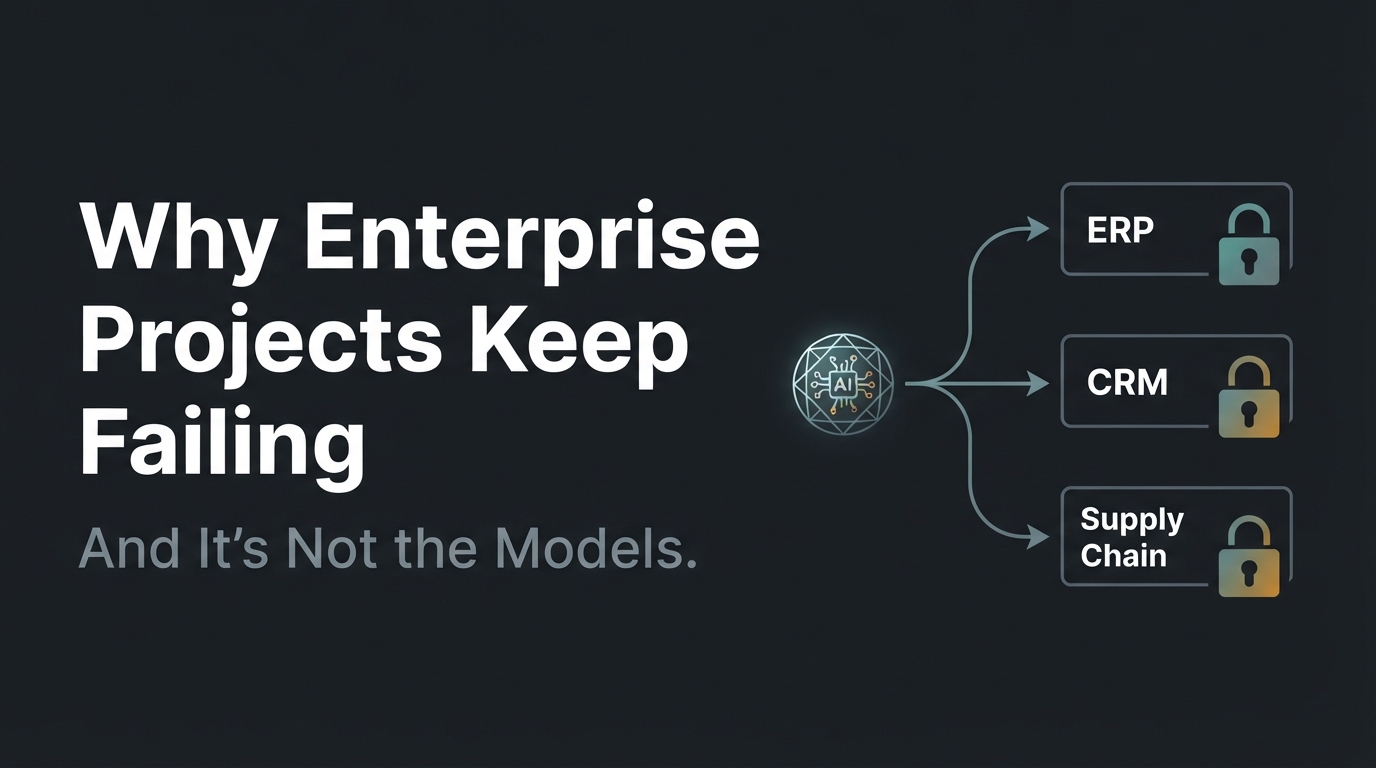
Most enterprise systems — ERPs, CRMs, supply chain platforms — were designed for one purpose: reliable transaction processing. Store data consistently. Enforce business rules. Comply with regulations. Report accurately. They did that job well.
What they weren’t designed for: being questioned. Being explored. Being combined with signals from other systems to surface patterns nobody anticipated when the schema was first drawn.
AI doesn’t just consume data. It needs data that is accessible, contextual, and evolvable — joinable across systems, queryable without a ticket, updatable as the business changes. Operational systems built for stability and compliance were optimized for the exact opposite of that.
The assumption baked in at design time was simple: this system’s data belongs to this system. Every other system that needs it gets a scheduled export or a dedicated integration. That assumption worked fine for a world where humans interpreted reports. It breaks completely when a model needs to reason across all of it in real time.
The result: enterprises sit on vast operational data and find themselves functionally data-poor the moment they try to build AI on top of it. [²]
Wrong diagnosis, same outcome
The failure usually surfaces as a model problem. The AI gives inconsistent answers, drifts at scale, or fails in production after passing every demo. Teams respond by switching models, tuning prompts, adding retrieval layers. Sometimes that helps. It never fixes the underlying issue.
Wrong outputs are a symptom. The cause is that the model is reasoning over incomplete, decontextualized, or structurally inaccessible data. You can’t prompt-engineer your way out of a data architecture problem.
The pattern looks like this: a team sees inconsistent customer-facing responses from their AI, escalates to the model vendor, switches to a more capable model, runs evals — and the numbers improve in testing. Then production degrades again within weeks. What nobody checked: the CRM data the model reasons over has missing context fields for 30% of accounts, populated inconsistently across regions. The model was making its best guess with incomplete inputs. Every new model made better guesses. None of them had the right data.
I watched a team go through three model swaps in two months. Each swap came with a round of internal demos that looked better than the last. Each one degraded the same way in production. Nobody asked why until the fourth swap was being approved — and by then, the answer was obvious: the product catalog data they were querying had no price history attached, only current price. The model was doing its best reasoning with one hand tied behind its back.
This is also why vendor-bundled AI rarely satisfies. It works within its own walls. The intelligence enterprises actually want — correlation across CRM, supply chain, and support logs — requires data to be open by design. Most operational systems were never designed with that in mind — they were designed to record transactions reliably inside their own boundary, and that was the right design choice for the problem they were solving.
The question that actually matters
Before asking “which model should we use?” the more load-bearing question is: can the systems that hold our operational data actually support AI workloads?
That means honest answers to:
- Can relevant data be accessed without friction across systems?
- Are data contracts stable enough that AI outputs won’t drift as the underlying schema changes?
- Is there enough context attached to the data for a model to reason correctly — or just fields in a table?
- When AI-generated actions touch downstream systems, can you trace what happened and why?
Most enterprises haven’t asked these questions yet. They’re running AI initiatives on top of data infrastructure that wasn’t built for them. When the project stalls, the model gets blamed.
The model was fine.
Fixing the data layer is the right first move — but teams that wait to fix it are accumulating a compounding liability with every sprint. The AI Debt You’re Accumulating Every Sprint You Wait breaks down what that costs, technically and competitively.
The organizations pulling ahead aren’t starting with better models. They’re starting with a harder question: “What would we need to change about how we manage and expose our data before AI could reliably add value here?”
That question implicates systems, teams, and architectural decisions made years ago. But it’s the right question — and it’s the one that separates pilots that ship from pilots that stall.
Once the data layer is unblocked, the next wall most teams hit is governance. Building an AI Strategy That Governance Doesn’t Kill shows how to build a compliance framework that accelerates AI velocity instead of strangling it.
Next: The data architecture problem doesn’t just stall projects — it accumulates inside your codebase with every AI-assisted feature your team ships without fully understanding what they built. → Post 2: The Cognitive Debt Crisis in AI-Augmented Codebases
Citations
[¹] O’Reilly, AI Adoption in the Enterprise 2021 Survey — oreilly.com
[²] CrowdFlower (now Appen), reported in Forbes (2016) — forbes.com